
Thursday, January 1st, 1863. The Regiment began 1863, its second full year of Federal service, in its camp of canvas-roofed log huts, a mile-and-a-half north, northwest of Falmouth, VA. In the two weeks since the Regiment’s return to the camp after the Battle of Fredericksburg, it had settled in the routine of winter camp life – resting, drilling, taking its turn on picket duty, parading, and generally recovering from the ordeals of the previous three months. Some records indicate that the units in the Army of Potomac received a tot of rum to mark the new year (pictured), but there is no specific record indicating whether or not this included the Irish Brigade. One may hope it did!
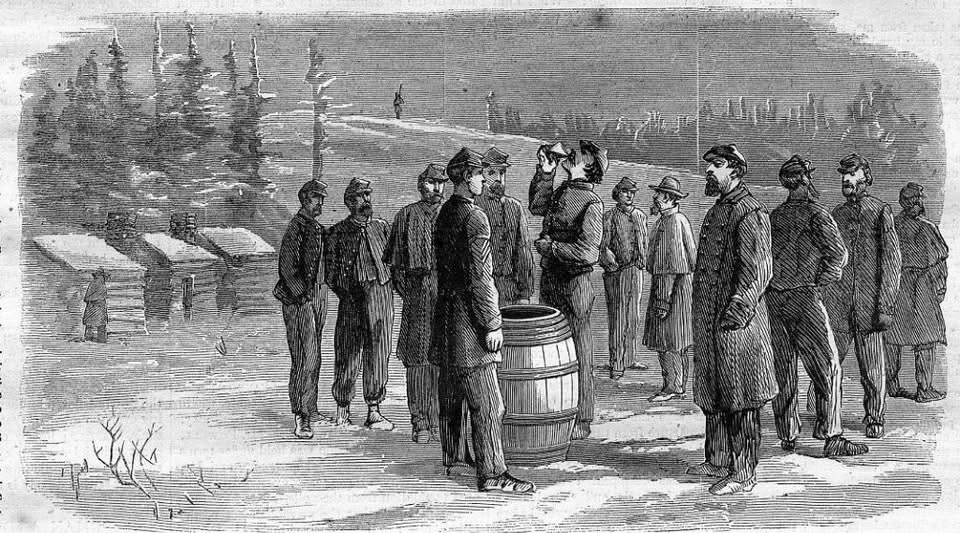
Harper’s Weekly, 1865
Our usual sources – John Ryan of the 28th Mass, Chaplain Corby of the 88th NY (at this point the only Chaplain still with the Irish Brigade), Captain Conyngham of the 69th NY, and William McCarter of the 116th PA – are silent on the events of this period. Peter Welsh carries on his correspondence with his wife, writing her on January 4th, 7th, and 14th; receiving letters from her on the 5th and the 12th. These letters are full of the domestic chatter of spouses, descriptive of their conditions, thankful for things sent and received – $20 to her and an Agnus Dei medal for him. (This medal is a Catholic devotional item featuring the “Lamb of God,” symbolizing Jesus Christ’s sacrifice, used for spiritual protection and as a reminder of baptismal promises.).
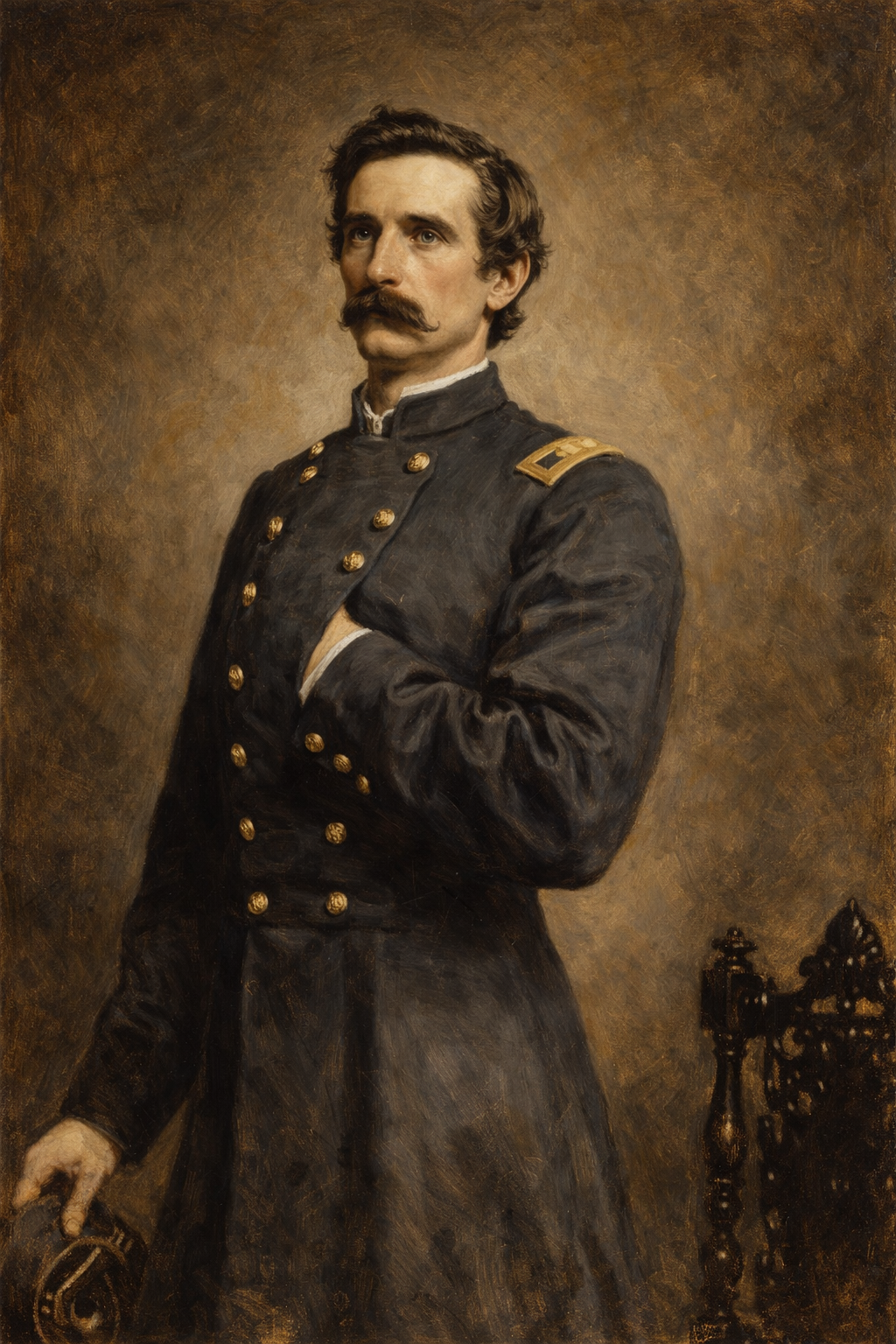
Two items of interest may be derived from Peter Welsh’s letters. The first, from his letter of January 4th, is commentary of the 28th’s Colonel (Richard Byrnes). Welsh tells his wife: “…Thier (sic) is good many of our regiment who hate our Colnel (sic) because he is a man of decipline (sic) …he is the right kind of officer to have in command. He will alow (sic) neither Officers nor men to shirk their duty…there is no partiality shown to any…he also looks out for the rights of the his regiment…if there is any cause of complaint he makes it his business to look after it immediately.” Welsh’s commentary shows his maturity as a man and a soldier, appreciative of his tough but fair commander. As mentioned in early entries, Byrne had been appointed the Commander of the 28th in October 1862, immediately professionalizing the Regiment, relieving personnel and instituting drill and better practices. This was not universally popular and a number of officers resigned over the elevation of an outsider.
The second notable thing that may be derived from Welsh’s letters, as well as the other sources, is the utter absence of any mention of Lincoln’s Emancipation Proclamation, which went into effect on the 1st of January. The Irish-American soldier of the Civil War, as well as its community at home, were not Abolitionists as a general rule – in February, Welsh would mention to his wife (in response to rumors that Massachusetts was raising colored regiments) that the feelings against colored people was “intensely strong”..and that they are “…looked upon as the principal cause of the war and this feeling is especially strong in the Irish regiments.” This may certainly explain the absence of comment on the Proclamation, which was likely known, as newspapers were available, and Welsh’s wife had sent him a Boston Pilot, for which he was grateful.
Sources: Welsh “Irish Green and Union Blue” pgs 51-58. For the Irish view of colored people, Welsh, pgs 61-62; Bell Irvin Wiley “The Life of Billy Yank” pg 109; Susannah Ural Bruce “The Harp and the Eagle: Irish American Volunteers and the Union Army, 1861-1865”, chap 4; Damian Shiels “Green and Blue: Irish Americans in the Union Military 1861-1865” pg 5.
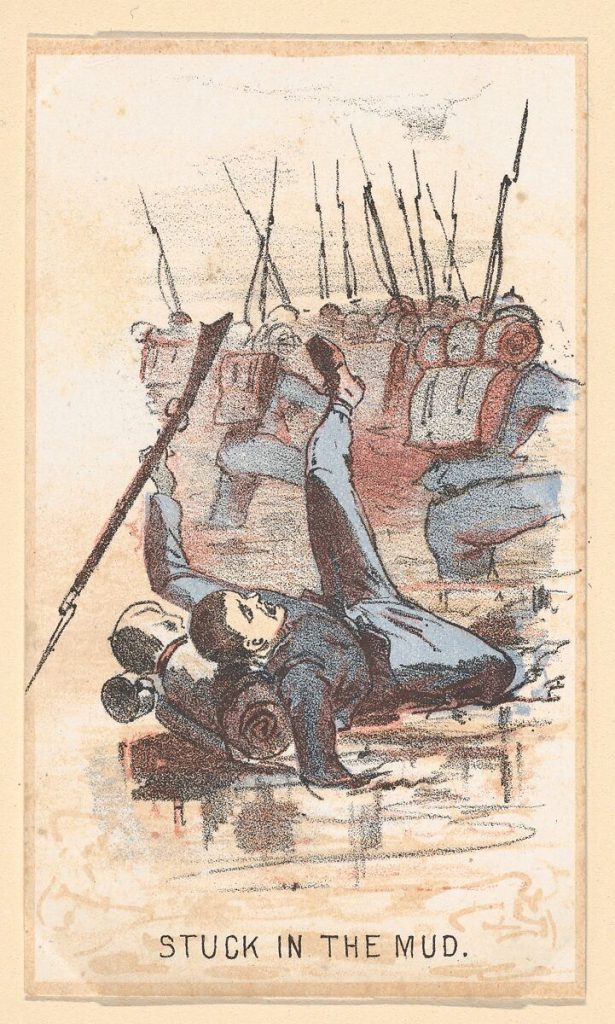
Tuesday – Thursday, January 20t -22nd, 1863. These dates mark the infamous “Mud March” of the Army of Potomac, Burnside’s failed attempt to move west of Fredericksburg, cross the Rappahannock River, and get on the flank of Lee’s Army of Northern Virginia. Tuesday 20 January started fair, but by evening, the skies opened and a torrential winter rain fell, swelling the river and turning the roads into ankle-deep muddy bogs. The Second Corps, containing the Irish Brigade, was to be last in the order of march, and both John Ryan and Peter Welsh note that while they were ready to move, they never did, thus being spared the ordeal – a rare piece of luck for the Irish Brigade. Both noted watching other units straggle back to their camps, exhausted, wet, and muddy. Welsh, in a letter dated 23 January, notes that some of their pay had caught up – at least through November, 1862 – he credits this occurrence to their “old division” (e.g, in the Ninth Corps.)
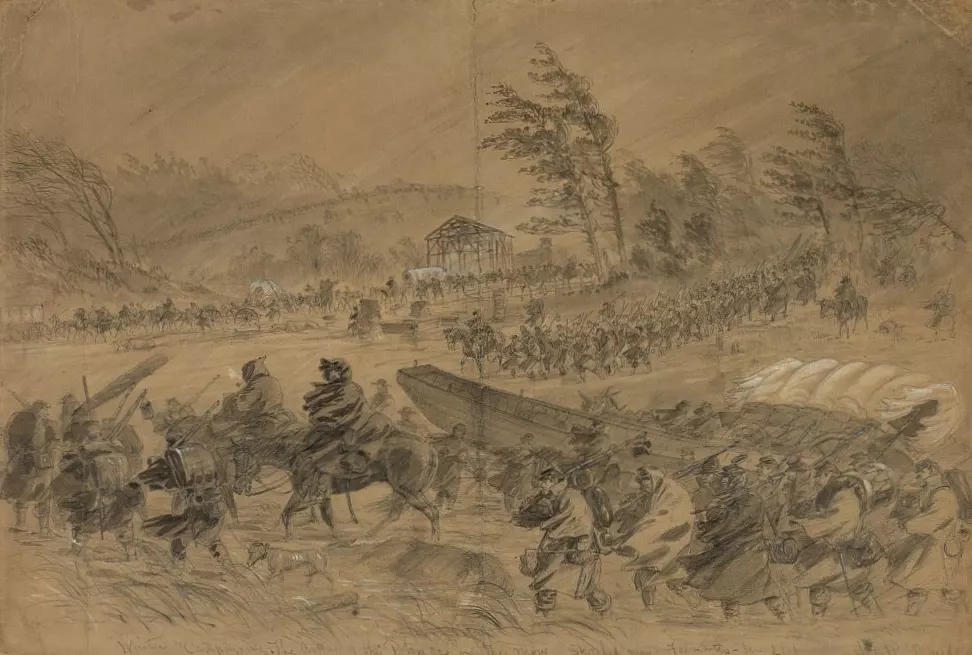
Sources: Ryan “Campaigning” pg 88-89; Welsh “Irish Green & Union Blue” pg 59.
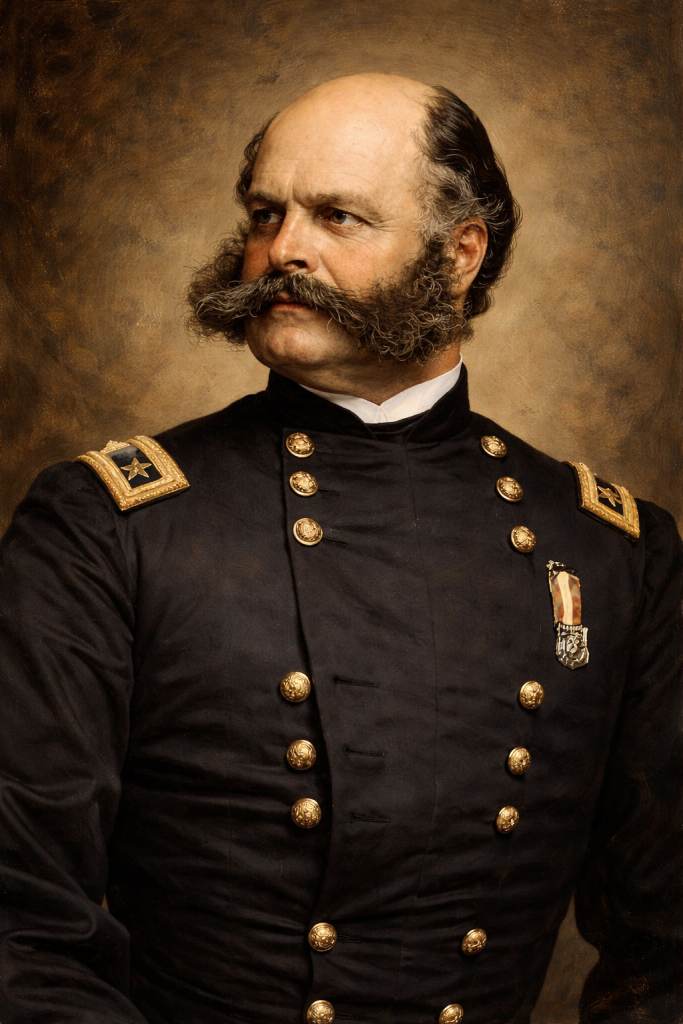
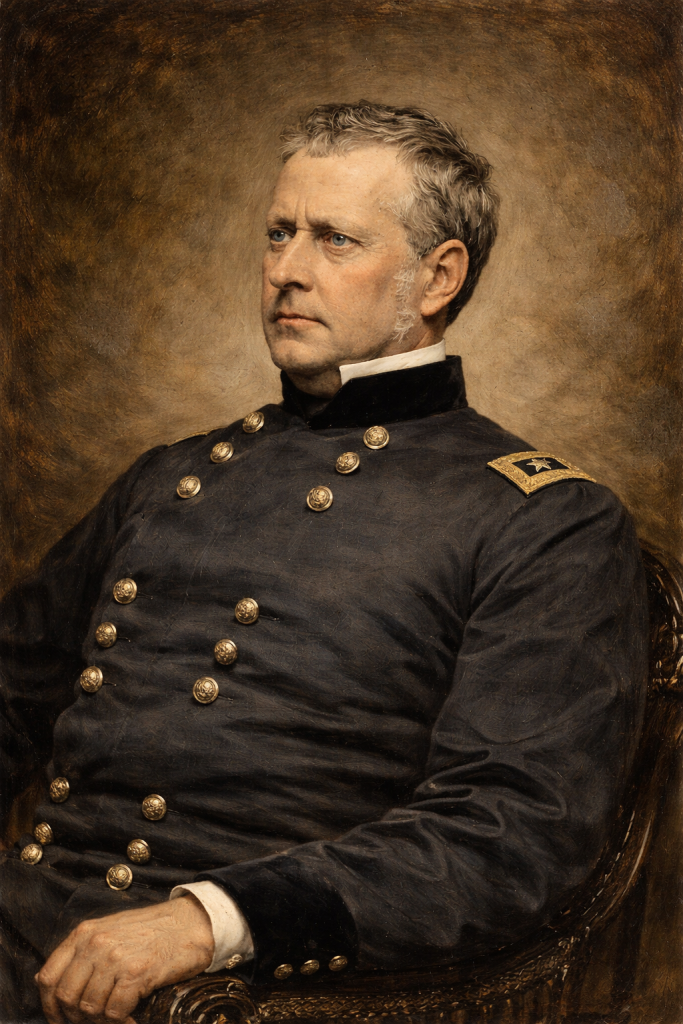
Monday, January 26th, 1863. Major General Ambrose Burnside is relieved as Commander of the Army of the Potomac, and is replaced by Major General Joseph “Fighting Joe” Hooker. Neither John Ryan or Peter Welsh offer any commentary on this change – the 28th likely would have had an opinion on Burnside, as he was their Corps Commander throughout the Maryland Campaign. (It is generally believed that the IX Corps held Burnside in good favor.)
Sunday, February 1st, 1863. On February 1st, the Regimental strength was 25 Officers and 306 Enlisted men present for duty. On paper, the Regimental strength was 34 Officers and 612 Enlisted men. The difference reflected men detailed to other units, in hospital, captured, on leave, or simply missing. As point of comparison, one year prior, in mid-February 1862, the Regiment’s strength was 30 Officers and 910 Enlisted present for duty (37/925 on the rolls.) Additionally, over the course of 1862, the regiment had gain approximately 144 soldiers, although some of this gain is soft – a returned deserter counted as a “gain” as the soldier would have previously been a “loss.”
In one year of service, the Regiment had lost between 64 – 65% of its starting strength – dead, wounded, discharged, transferred, resigned, missing, etc. Of the approximately 750 plus (factoring in the gains) losses, 515 were attributable to battle action – a real indication that the 28th Mass was a “Fighting Regiment.”
The specific breakdown of those present in the 1 Feb 1863 report was as follows: Field/Staff – 5/2; Companies: A – 2/36; B – 2/26; C – 1/35; D – 3/36; E – 2/28; F – 2/23; G – 2/32; H – 2/24; I – 3/31; K – 1/33 Total Present – 25/306 Total Present and absent – 34/612

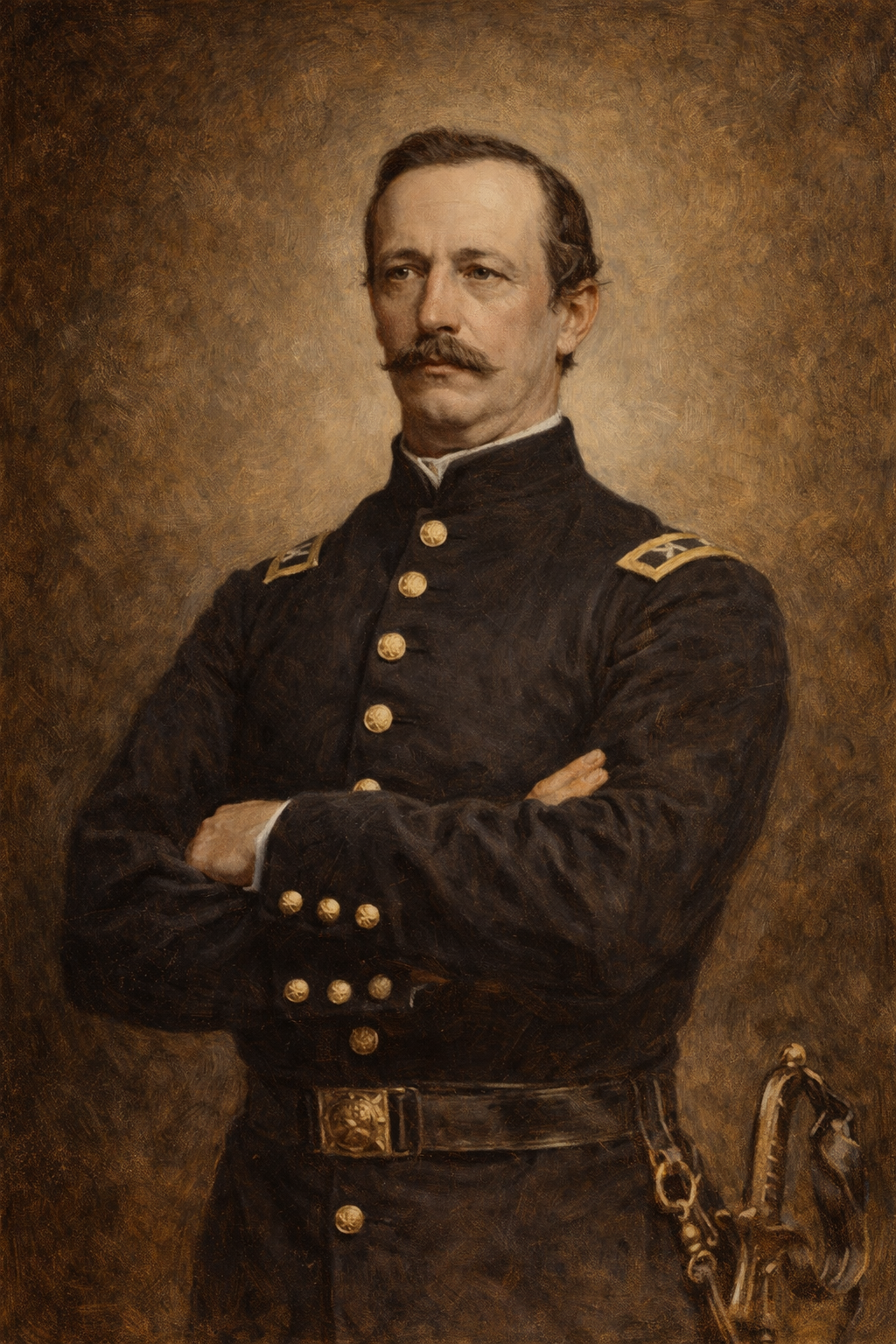
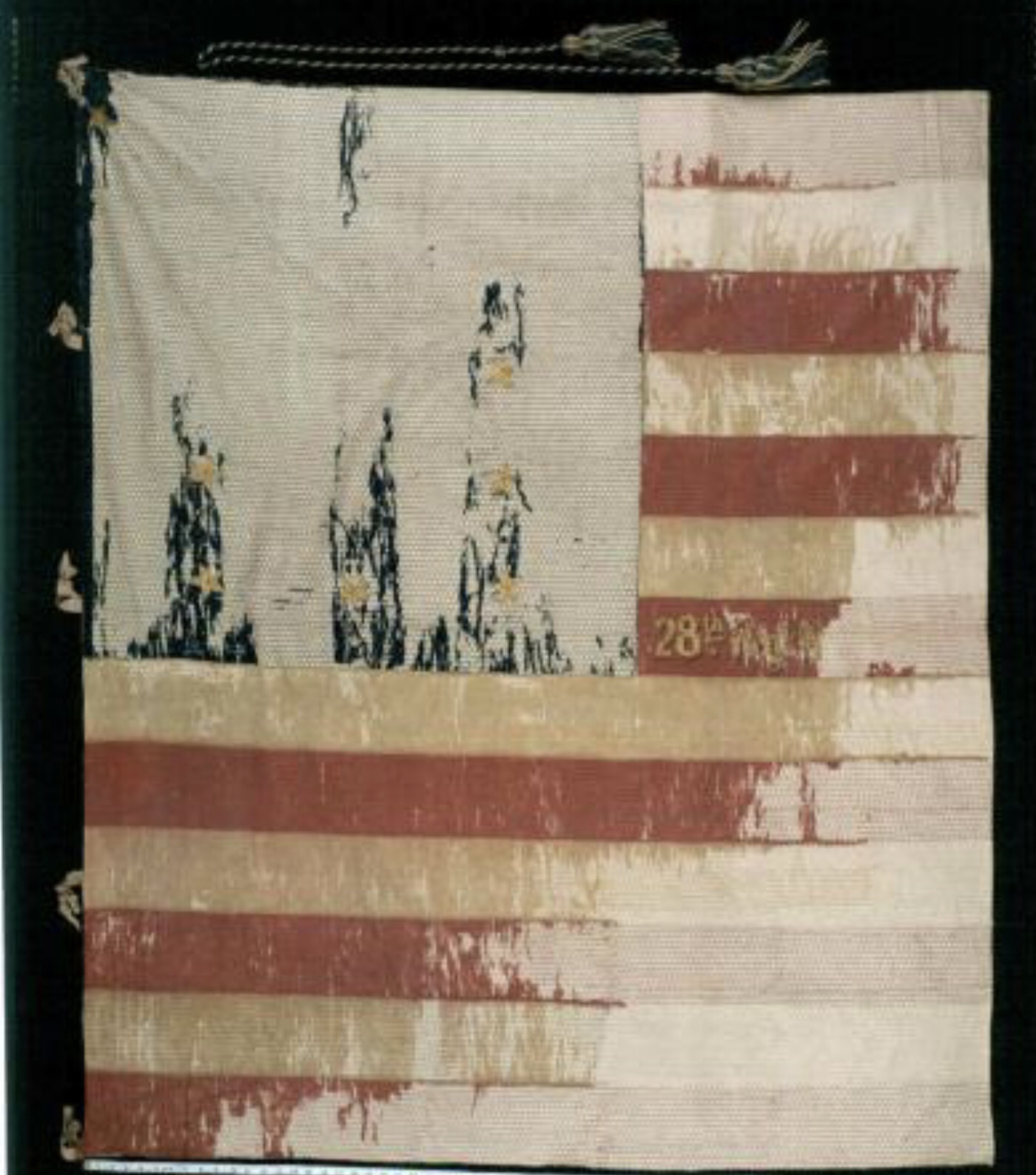
Sunday, February 15th, 1863. Midway through a quiet month in the regimental camp near Falmouth. Peter Welsh writes his wife and notes that his Company (K) Commander, Captain Charles H. Sanborn has returned from Boston with new flags, saying “our captain has got back and brought a new green flag for the regiment.”
Sanborn had been wounded at Fredericksburg and subsequently went back to Boston just after Christmas, bearing the Regiment’s tattered flags (First National and 1st Irish) from its year of hard campaigning in 1862. On his return, he carried a new National flag – certainly the “Second National.” The Massachusetts State House Battle Flag Collection does not have the new green Regimental, but it is believed to be a replica of the First Irish (Pilot) Flag.
Saturday, February 28th, 1863. The monthly report: Field/Staff – 5/2; Co A – 2/38; Co B – 1/27; Co C – 1/36; Co D – 3/35; Co E – 2/28; Co F – 2/27; Co G – 1/35; Co H – 3/26; Co I – 2/30; Co K – 2/34
Total Present – 24/318 Total Present and absent – 31/583 Gain – 9, Loss 41
Tuesday, March 17th, 1863The celebration of the Irish Brigade of Saint Patrick’s Day 1863 is legendary. Set on the parade ground between the Irish Brigade camp near Falmouth and the Divisional Headquarters of General Hancock, the Officers of the Brigade organized a series of events to mark the Saint’s Day. John Ryan lists these as “…horse-racing and hurdle jumping, for which there were prizes offered and for mule racing. In the mule race, the prize was for the one that came in last…” Ryan also catalogued that they also “…had foot racing, sack racing, picking up stones, climbing a greased pole, which had a thirty-day furlough and thirty dollars (n.b.: more than two months pay for a Private) attached to it…” (the winner being the man who climbed the greased pole.) There were also my other sports “too numerous to mention, which the enlisted men and officers enjoyed very much.” One estimate has more than 20,000 soldiers witnessing the horse-racing, to which General Meagher reportedly offers a $500 prize.
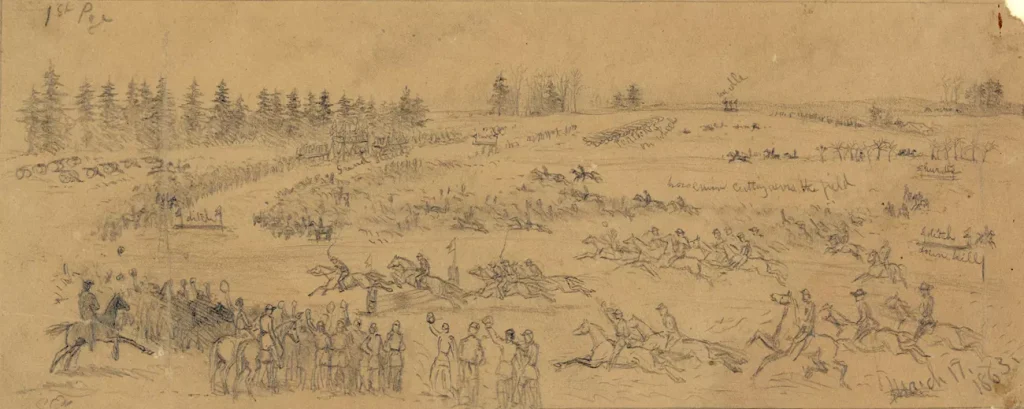
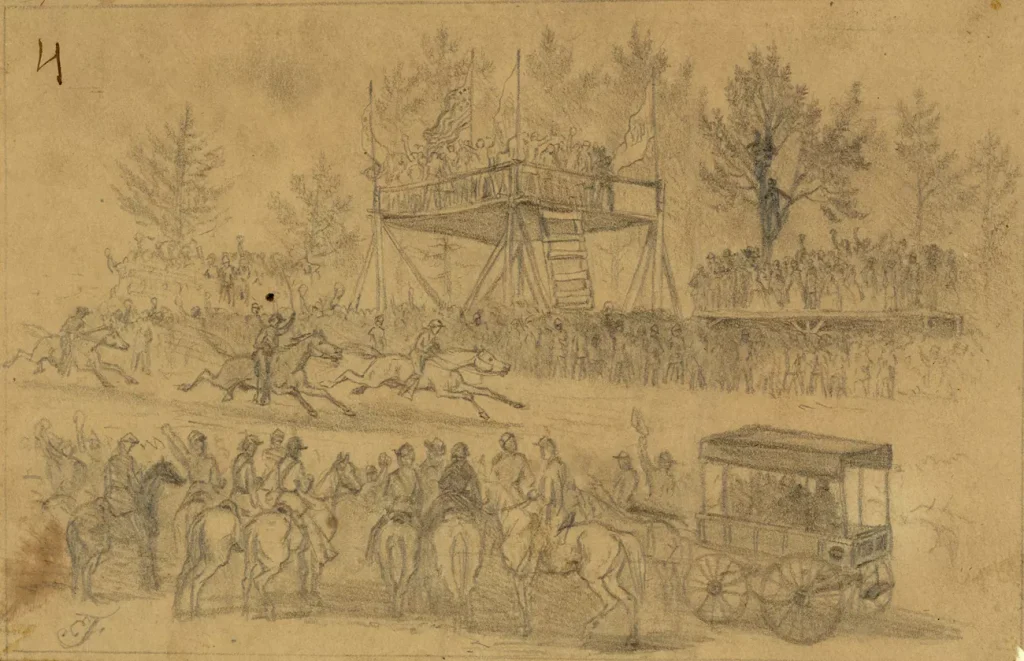
Brigade Chaplain Father Corby of the 88th NY was so struck by the day’s festivities, that he dedicated an entire chapter to this event in his memoirs. He celebrated a Catholic Mass to start the festivities, in a “…rustic church” specially made for the occasion by the men of the Brigade, made ofm15-foot pine logs place upright in the ground TW-feet apart, with accompanying rafters, all interwoven with pine branches. Seating was constructed with logs and camp chairs were made available for the luminaries that attended. Per Father Corby, here included AoP Commander Maj Gen Hookwr and many, if not most, of the army’s Generals.
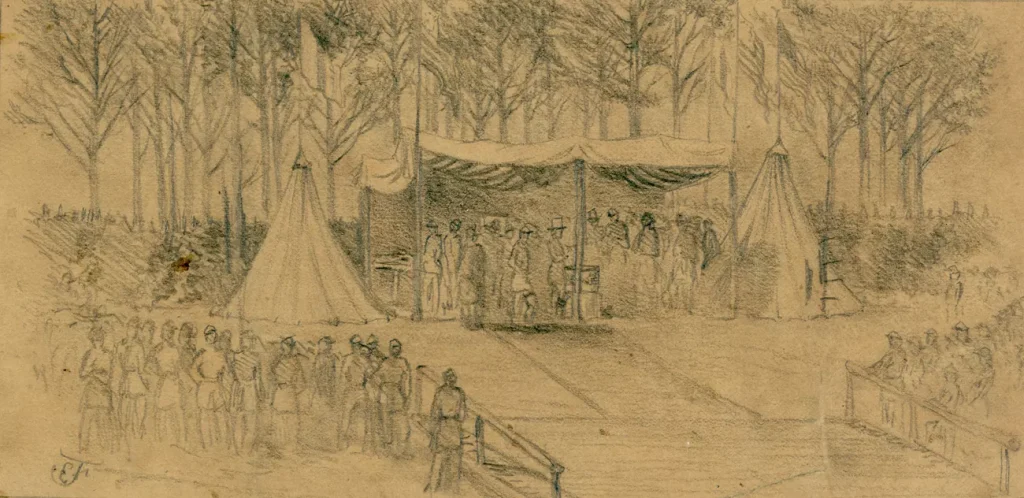
The day’s festivities concluded with the men back in the camps. At General Meagher’s Headquarters a large platform had been erected and jig dancing and drinks marked the party. Ryan reports that “…the side of an ox, thirty-five hams, two pigs stuffed with boiled chickens and any amount of chickens, ducks, and game” comprised the victuals. Drins were likewise abundant – “…eight baskets of champagne, eight gallons of rum, and twenty-five quarts of whiskey.” Each man in the Brigade received “two gills of whiskey.”
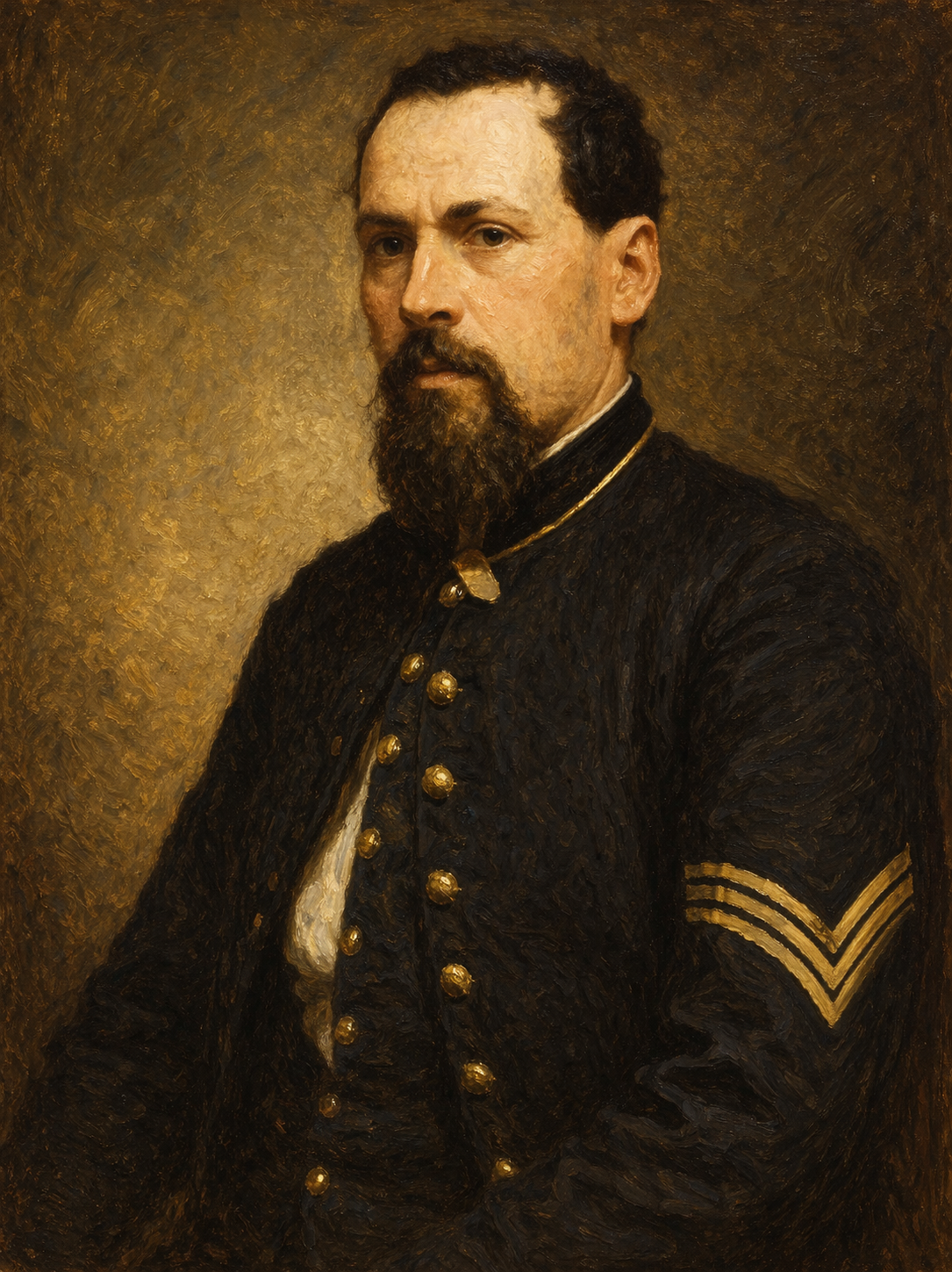
Towards the end of the day, an alert to march was given, in response to some skirmishing then going on near Kelly’s Ford between approximately 2100 US Calvarymen and some 800 Confederates. The Irish Brigade was not in fact ordered out, but the alert had an effect on Peter Welsh. As the regiment fell in, the Regiment’s Color Bearer did not report with the Regiment’s Green Tiffany Flag, and could not tell where it was (Note – perhaps the 2 gills of whiskey had an effect?). in any case, as Welsh reported to his wife in a letter on March 19th, he was sent to collect it from the Colonel’s tent, and was made Sergeant and Regimental Color Bearer on the spot. Proud to be selected to carry the Color as he was, the new Sergeant Welsh was doubly glad to be given the honor on Saint Patrick’s Day.
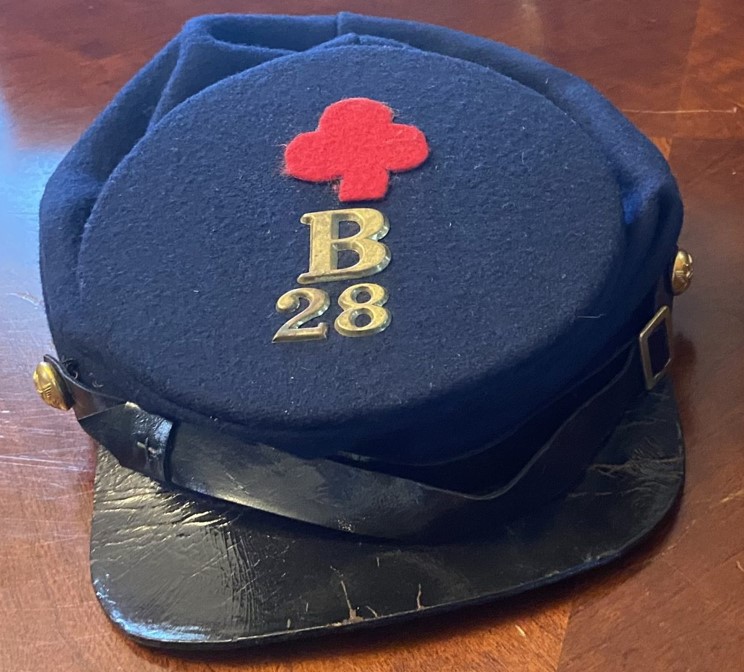
Saturday, March 21st, 1863. On this date, Army of the Potomac Commander Major General Joe Hooker issued a circular directing the Chief Quartermaster to furnish Corps and Divisional badges to the Army for “The purpose of ready recognition of corps and divisions in the army, and to prevent injustice by reports of straggling and misconduct through mistakes as to its organization.” The circular went on to say that the badges were to be “…securely fastened upon the center of the top of the cap” and that Inspecting officers would check to make sure that badges were worn as designated.
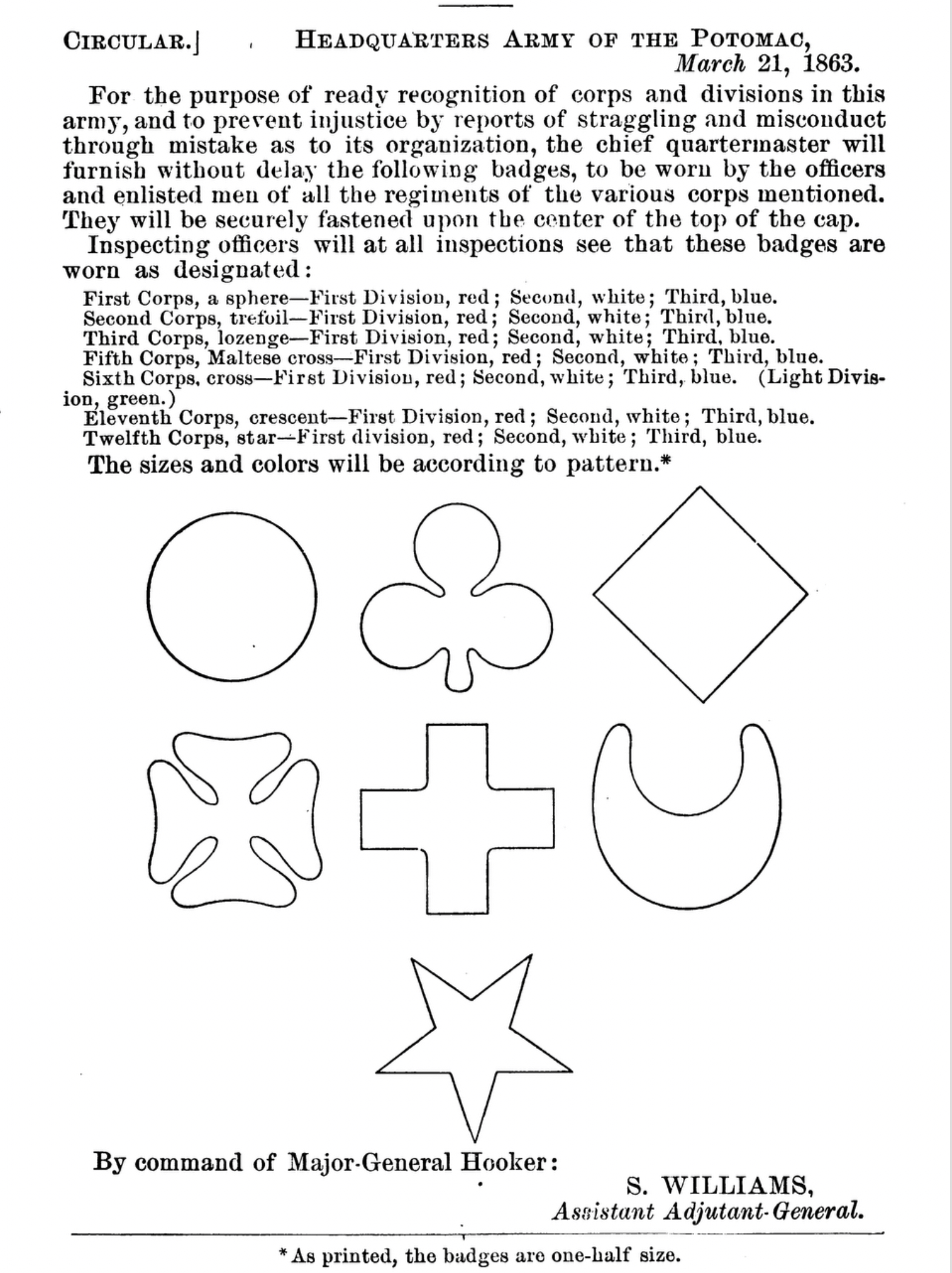

Each Corps received a distinctive badge, with the colors of the badge changing by division – Red (1st), White (2nd), and Blue (3rd) being the natural choice of colors. AoP Chief of Staff Maj Gen Dan Butterfield designed the badges, and initially soldiers in the First, Second, Third, Fifth, Sixth, Eleventh and Twelfth Army Corps, as well as the AoP’s Calvary were the first to receive Corps badges – 122, 578 in total.
Corps badges were initially envisioned as way to facilitate organization and order, but they soon proved a source of unit pride and esprit, with a positive effect on morale. The new symbols soon adorned every soldier and wagon. Sutlers began to sell fancy versions as the idea caught fire. Jeweled versions of high quality were eventually offered in New York and Philadelphia, so popular was the idea.
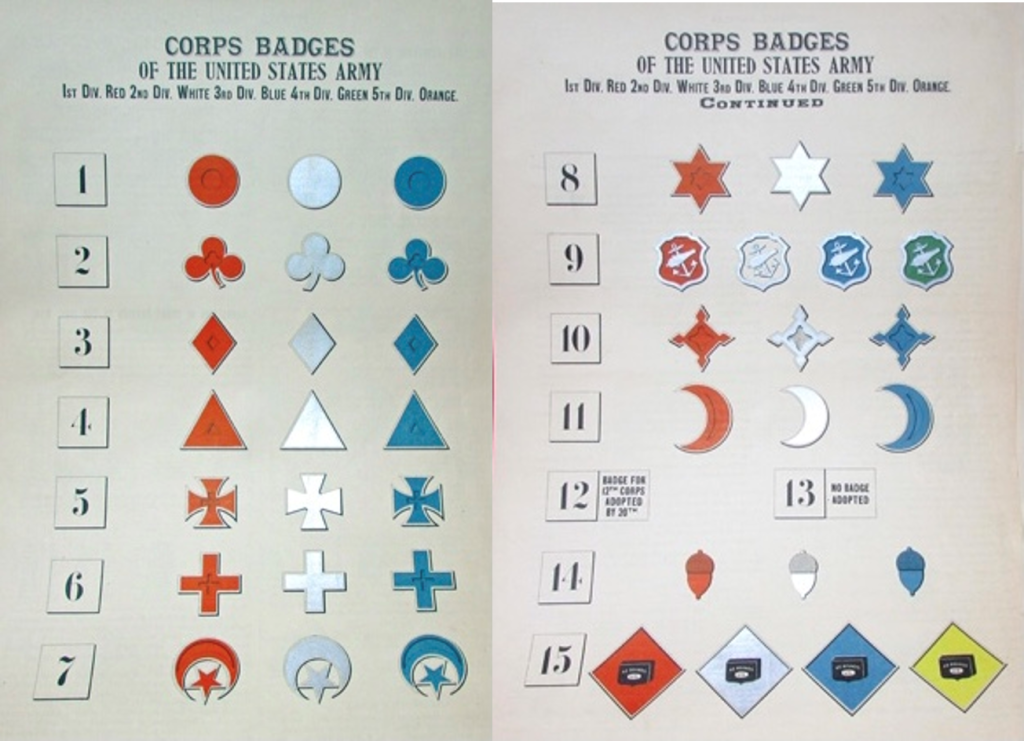
Sources: O.R., Volume 25, Chapter 37, Part II, pg 152; Conner/Mackowski “Seizing Destiny”pgs 186-187.
Tuesday, March 31st, 1863. The monthly report: Field/Staff – 5/2; Co A – 2/39; Co B – 1/30; Co C – 1/36; Co D – 3/36; Co E – 2/32; Co F – 2/27; Co G – 1/34; Co H – 2/28; Co I – 1/30; Co K – 2/33
Total Present – 22/327 Total Present and absent – 30/536 Gain – 5, Loss 53
Sunday, April 5th, 1863. The Regiment spends what Peter Welsh called “a dull Easter” in their camp near Falmouth. There was snow overnight Saturday into Sunday, stormy weather that turned to rain by Easter morning, which turned the camp into a “sluge” (sludge). The sun came out and the weather turned, in Welsh’s description, “beautiful.” Welsh’s Company (K) Commander Captain Sanborn bought the company 10 dozen eggs from a sutler at sixty-cents a dozen (and 75 cents per pound for butter) and despite the lack of bacon, made “a nice mess.” Welsh mentions that it was only his second taste of butter since the previous October (1862).
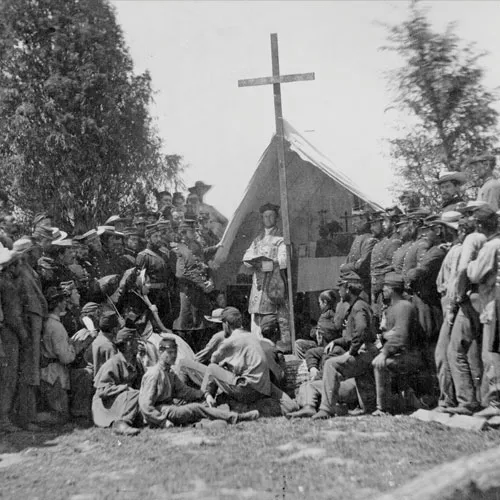
None of our other, usual 1st-person reporters – John Ryan (28th MA), Father Corby (88th NY), or Captain Conyngham (69th NY) – make mention of Easter 1863 for the Irish Brigade..but Father Corby describes that during April, a collection was made for “the Poor in Ireland.” The Irish Brigade sent $1,240.50 to the Archbishop of New York, of which the 28th Mass contributed the main share of $771.50. (Welsh 84, Corby 146-151)

Harper’s Weekly, April 25, 1863 (Colorized)

Wednesday, April 8th 1863. The Regiment participates in a grand review for President Abraham Lincoln, who was visiting the Army of Potomac in an effort to bolster morale. Color Sergeant Peter Welsh, in a chatty letter to his wife on 10 April, reports that that “ …old Abe was here ..he looks like he would soon go to kingdom come and there were few in the army who would be sorry if he was there..there is not in the ranks of the army a more miserable man..than old Abe…the paymaster would meet with a much heartyer (sic) welcome…”. (Welsh p 84)
Welsh’s sentiment’s reflect the complex relationship Irish-Americans had with Lincoln. Largely affiliated with the Democratic Party, certain of Lincoln political actions – such as the Emancipation Proclamation January 1863) and the Enrollment Act (AKA the Civil War Military Draft Act (March 1863) – were not well accepted well by the Irish-American community. The Enrollment Act itself would lead to the July 1863 Draft Riots in New York – riots which began in the Irish community.
Wednesday, April 15th, 1863. Still in Regiment’s winter camp near Falmouth, Peter Welsh writes his wife Margaret that the Army is getting ready to move but they don’t know where or when. The Regiment was taking its turn on picket duty but the fact that they had been issued eight days rations was an eloquent sign that a movement or march was soon to arrive. The Chancellorsville campaign and the start of a hard summer of marching and fighting were only weeks away. (Welsh 86)
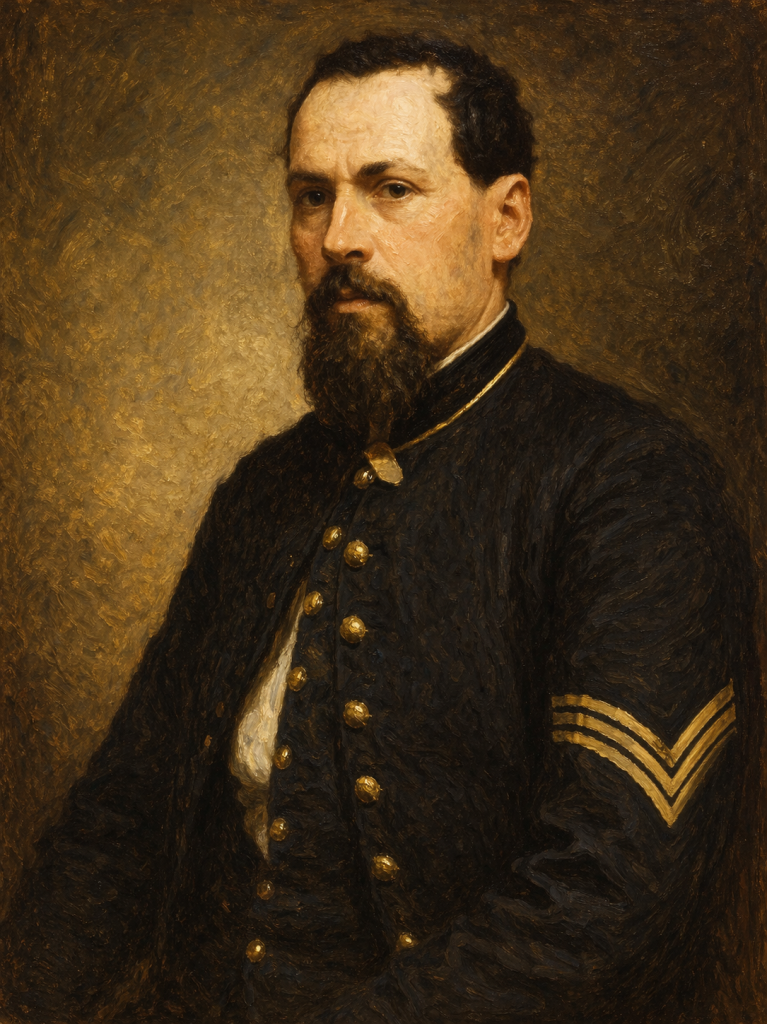
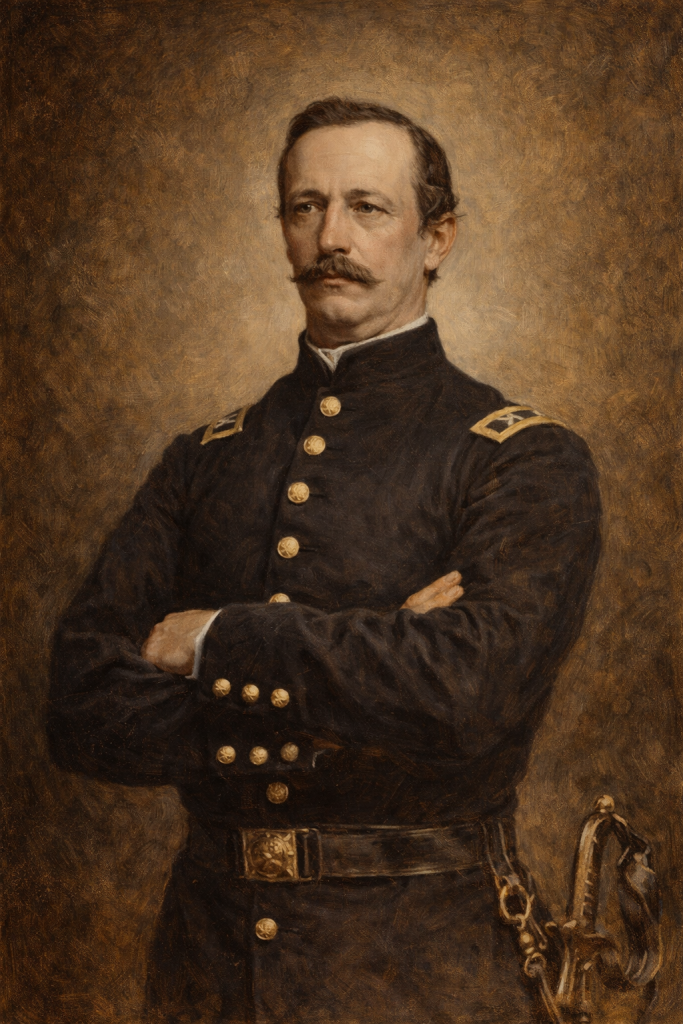
Monday, April 20th, 1863. 28th Mass Commander Colonel Byrnes had Captains Charles Sanborn of Company K and Jeremiah Coveney of Company F brought before a General Court Martial at Divisional Headquarters. There were numerous charges but the most significant of them was that the officers were engaged in “mutinous and seditious conduct” while the Regiment was expecting orders to march against the enemy. Peter Welsh describes the affair in a letter to his wife on May 13th – the apparent issue was Colonel Byrnes’ decision to bring in new officers from outside the Regiment, rather than commissioning from within the Regiment. (As an aside, once enlisted men were commissioned, they could resign and leave the Army – hence it was a valuable reward for those who had seen much fighting.) Sanborn and Coveney were overly vocal in their protests, hence the charges and subsequent Court-Martial.
Two days of testimony proved some of the lesser charges, but the most serious charge of mutinous conduct was not proven. Both officers were sentenced to receive a public reprimand by the Major General (Hancock) Commanding the Division. Both Officers were with their Companies for the Chancellorsville Campaign. Further, both men survive the war; both are wounded in 1864 fighting. Coveney eventually becomes Boston’s Postmaster-General.
Source: Welsh, pgs 95.97.
The Chancellorsville Campaign
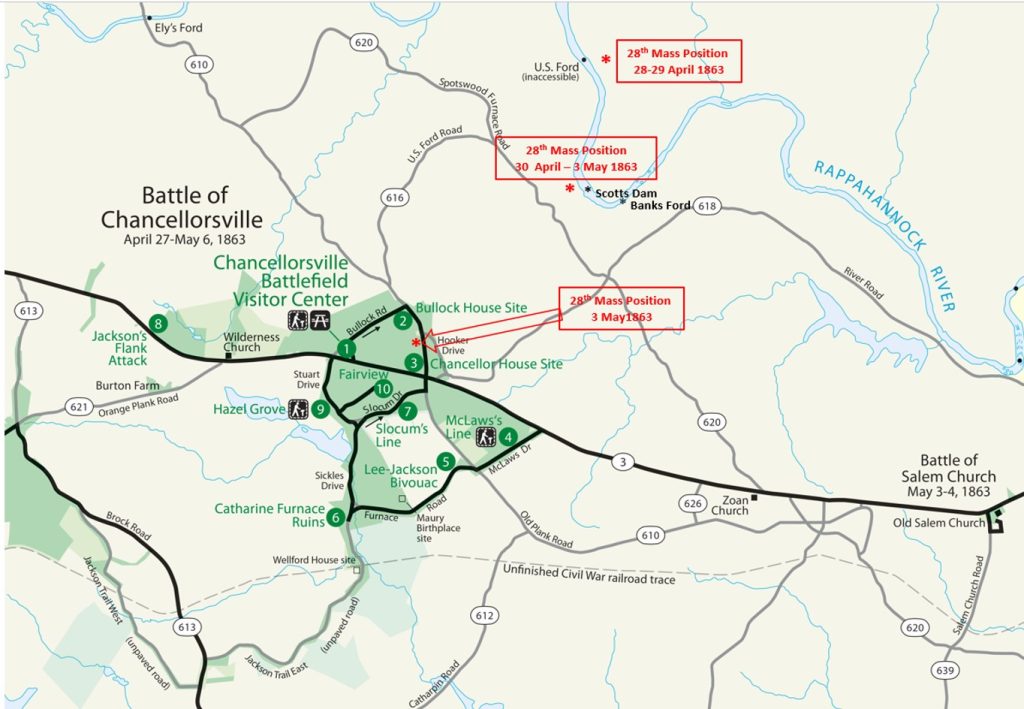
Monday – Wednesday, April 27th – 29th 1863. The Irish Brigade left their Falmouth winter quarters “…at noon and marched until midnight” The men rested in woods until morning and reached US Ford on the night of the second day (the 28th). Brigade Commander Brig Gen’l Meagher – who had been in New York for much of March and April recuperating from his Fredericksburg wound and trying to recruit new soldiers for the Brigade – caught up to the Brigade at Banks Ford on the morning of April 28th and re-assumed command from Colonel Patrick Kelly of the 88th NY. At US Ford, the Regiment “did the usual picket duty” until Thursday 30 April. The route followed was generally west on the north bank of the Rappahannock , passing by in turn, Bank’S Ford and Scott’s Dam/Ford before reaching US Ford, a distance of approximately 15 miles.
Sources: Corby, pgs 152-153; Wylie, “The Irish General” p185; Ryan, pg 91.
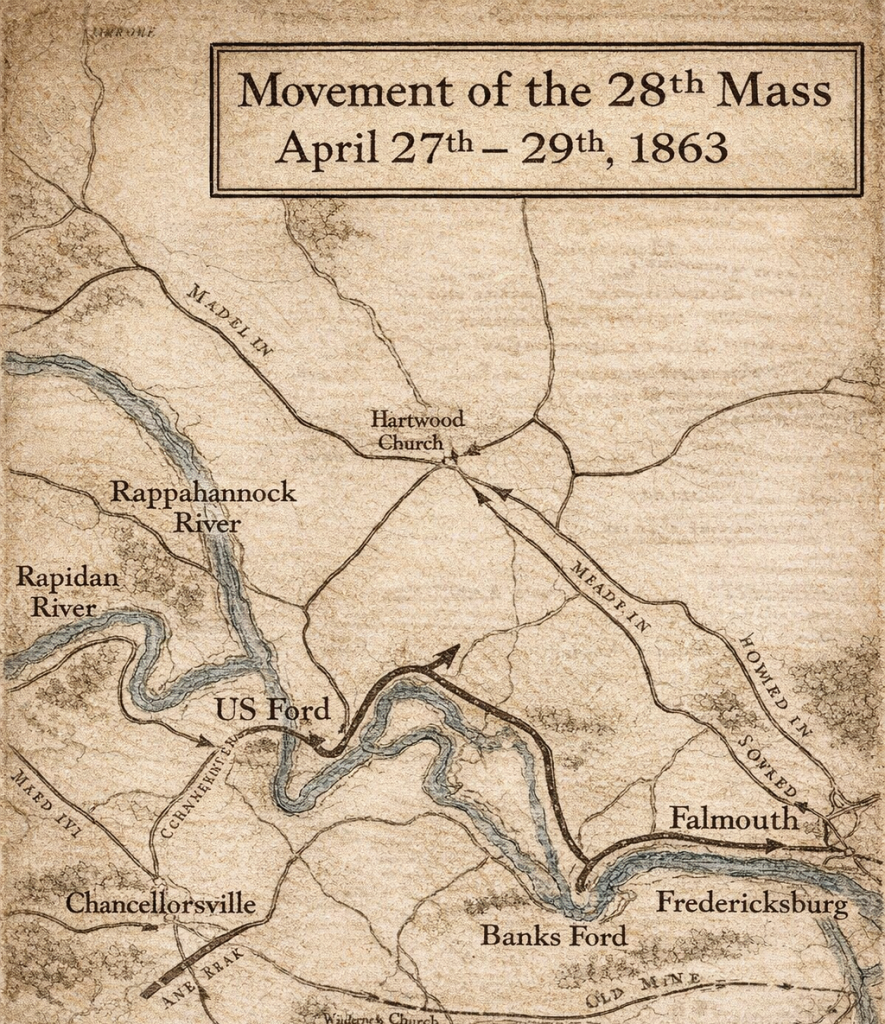
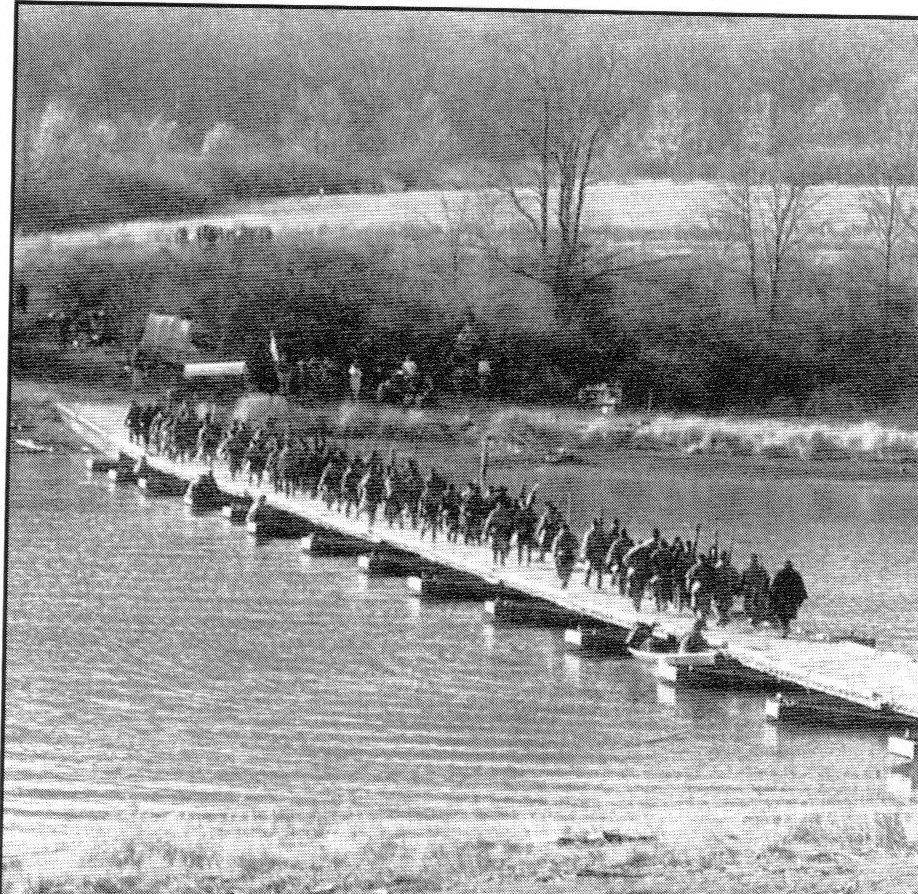
Thursday, April 30th, 1863. The Irish Brigade, including the 28th Mass, crossed south over the Rappahannock and “moved to the right of the Plank Road leading to Chancellorsville, a distance of about 6 miles.” Remained overnight. Several accounts mention crossing under moonlight. The Irish Brigade is minus the 88th NY who were detailed to guard the Corps ammunition train.
Sources: Ryan, p 91; Corby, p 153; Conyngham, p 394; Wylie pgs 185-6.
Friday, May 1st, 1863. The Irish Brigade marched in the direction of Scott’s Dam/Mill, 5 miles, arriving about 10 PM where the Brigade and the 28th Mass remained doing picket duty and building breastworks until the morning of Sunday, May 3rd. The Brigade occupied ground near the southern edge of Banks Ford, the 28th Mass on the right of the line facing forward. By the Brigade’s positioning, it is clear the mission was to protect the key crossing of the ford.


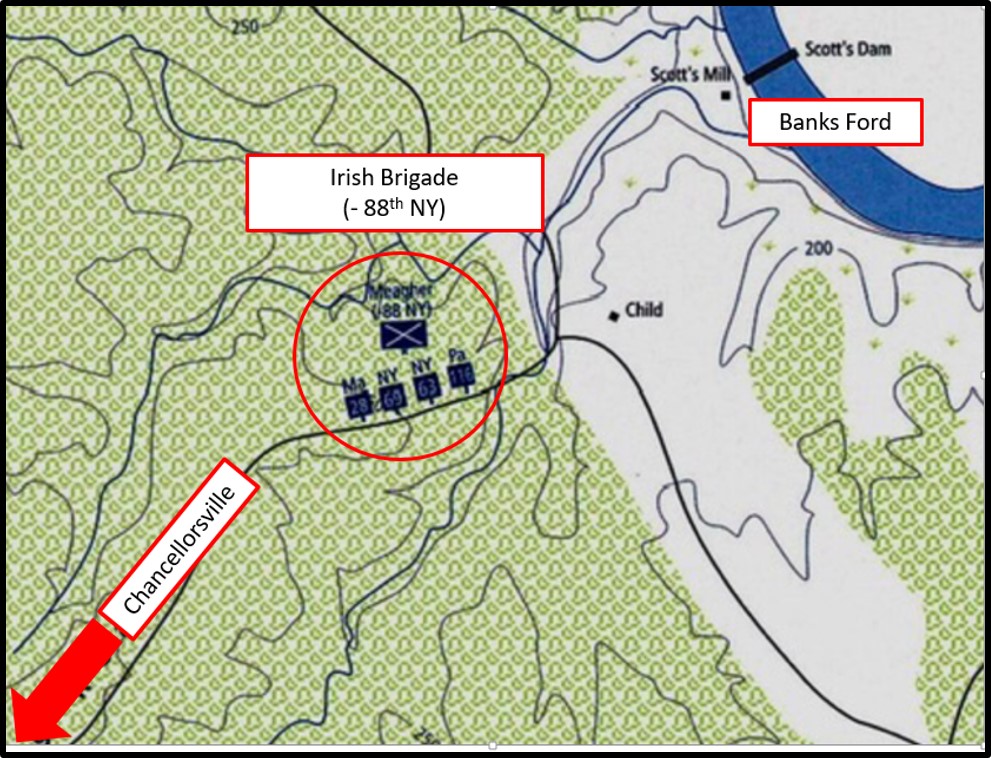
Separated from the rest of their Division as they were, and posted about 6 miles away from the main battle area, the under strength Irish Brigade missed the first several days of the battle around Chancellorsville, including Stonewall Jackson’s famous flank attack late in the afternoon of May 2nd. The Regiment could hear the fierce fighting however; Father Corby records that they “…could hear the booming of cannons and the bursting of shells.” Additionally, on the evening of the 2nd, the Brigade threw “…a line across the road and into the wood at Scott’s Mills, in order to intercept the panic stricken fugitives, who came rushing along; but, finding their retreat thus cut off, had to rejoin the army.” (Boston Pilot 30 May 1863 – Author not indicated, but almost certainly D.P Conyngham, as the text is very similar to the account in his history of the Irish Brigade.) Per Father Corby, the fugitives were stopped “at the point of the bayonet.”
Sources: Corby, Pgs 157-58; Ryan 90-91. Boston Pilot Volume 26, Number 22, 30 May 1863, p3, “The Battle of Chancellorsville and Scott’s Mills: The Irish Brigade in Action”.
The monthly report was also submitted this day – paperwork never ceases. Field/Staff – 2; Co A – 1/40; Co B – 1/32; Co C – 1/31; Co D – 1/35; Co E – 0/29; Co F – 1/29; Co G – 1/29; Co H – 2/27; Co I – 1/32; Co K – 2/31
Total Present – 13/316 Total Present and absent – 27/489 Gain – 10, Loss 60
Sunday, May 3rd, 1863. The Irish Brigade went into action in the Battle of Chancellorsville this day. On a day that dawned “bright and clear” – before 7AM, Meagher’s men had been called forward to help bolster the Federal line, which had been condensed during the night and had come under a multi-division Confederate attack that commenced at 5:30 AM. Father Corby offered a Mass at sunrise using “a rustic altar.’ He was barely done when the Brigade was ordered to move.

The Brigade moved along Mineral Springs Road (Map 1), moving to rejoin the Second Corps, then just north of the Chancellor House. Between 8-9AM, they had rejoined the Second Corps, and oriented themselves facing west, facing the enemy’s line of attack. There they joined the combat to control the Chancellorsville Crossroads (the intersection of Orange Turnpike, Ely’s Ford Road, and the Orange Plank Road.) The 28th Mass was on the right of Meagher’s line, with the 57th NY of Zook’s Brigade to their immediate right. The Brigade’s position was in thick woods and per the account in the Boston Pilot on May 30th, under “a most destructive fire of shot and shell” for about two hours. To their front were several companies of Sharpshooters, as well as other Federal elements, to include a battery from the 5th Maine Artillery. (See MAP 2 and MAP 2 INSET.)
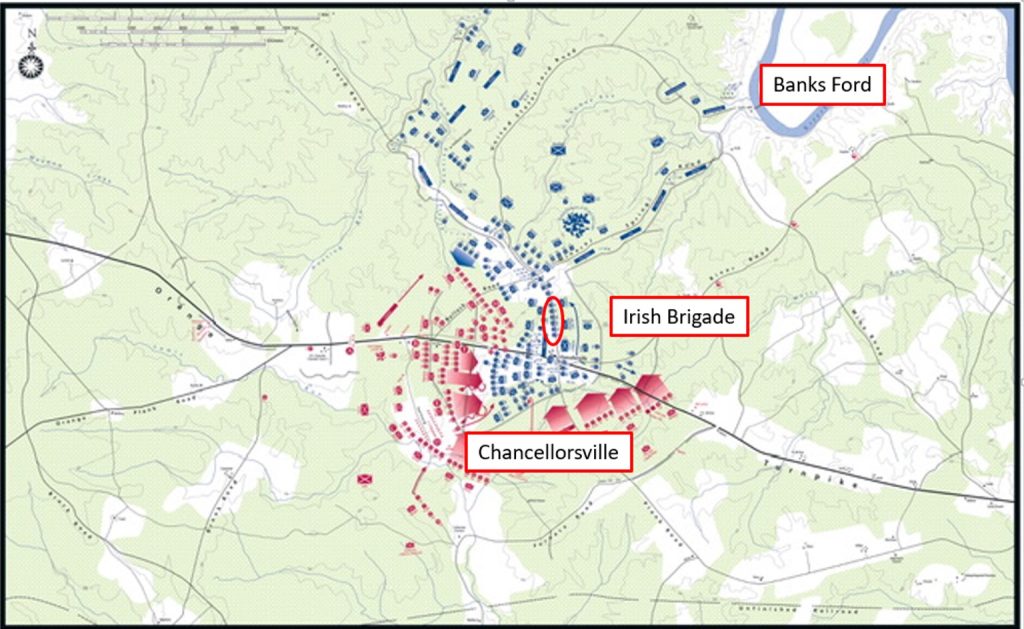
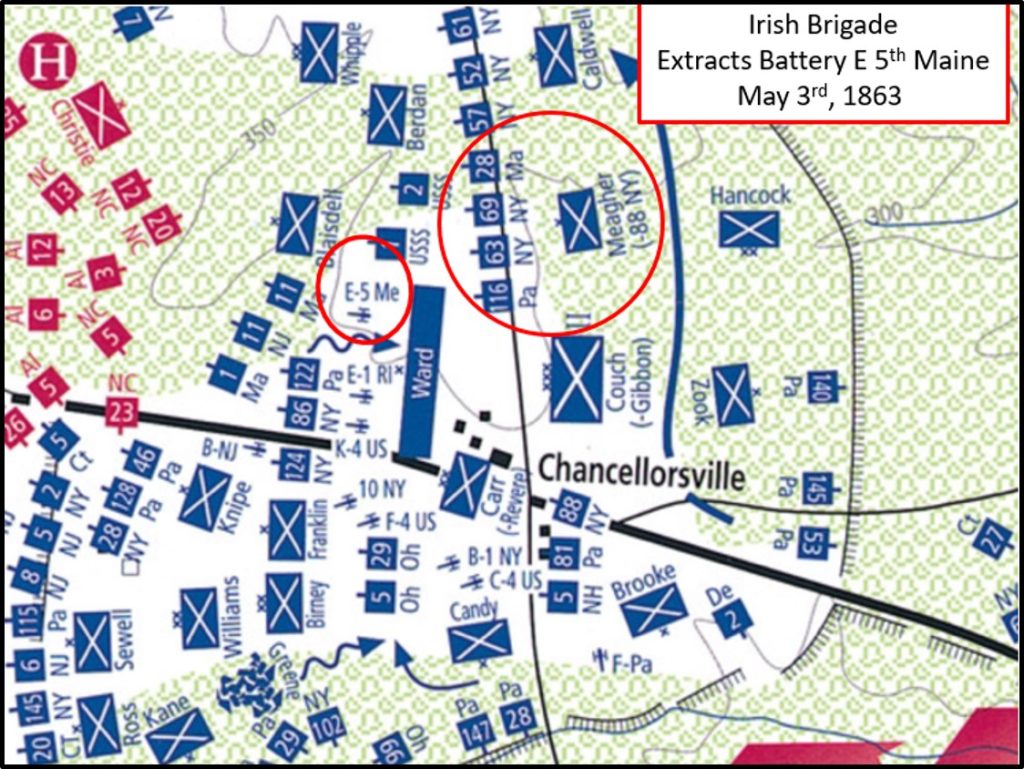
Mid-morning, the Brigade was ordered forward to support the 5th Maine Battery; a pivotal point for had the Confederates captured the Battery and turned its guns on the Federal line, the line could have been broken. Interestingly, the order came directly from Second Corps Commander Maj Gen’l Darius Crouch, and not the Division Commander Maj Gen’l Hancock – this would cause some confusion in subsequent reports. In response to this order, Brig Gen’l Meagher first ordered the 28th Massachusetts to send 50 men ahead as skirmishers, before the Brigade came charging forward “with the bayonet” per the CO of the nearby 124th NY. The Irish surged forward into what Peter Welsh described to his wife as “a hot place” and successfully brought off the battery manually, using ropes to haul the cannon to safety. It is likely that the cannon were mostly hauled off by soldiers of the 116th PA, as they were the Irish Brigade unit closest to the Battery’s position; later on, the Boston Pilot article on May 30th made note of this brave feat of arms without attributing the action to any particular regiment of the Brigade.
As May 3rd progressed, Conyngham recorded that “…a continual fire of musketry was kept up…”. John Ryan’s memoirs indicate that night, the Regiment (and presumably the Irish Brigade), moved down the Plank Road about two miles, built breastworks and rifle pits, stood picket duty —“incessantly until about 11PM on the 5th” (Tuesday) when the army began to withdraw towards US Ford. Other reports say the Brigade retired circa 4PM – with Peter Welsh telling his wife on May 7th that they “…fell back a half mile and built a breast work all along our line …in a few hours there was miles of breast work built.”
The Regiment suffered 26 casualties in the fighting – 10 KIA, 15 WIA, and 1 MIA. Another 5 soldiers are captured. (The next Monthly Report (below, May 31st) will indicate a loss of 31 soldiers.)
Sources: Corby, p 157; Boston Pilot Volume 26, Number 22, 30 May 1863, p3, “The Battle of Chancellorsville and Scott’s Mills: The Irish Brigade in Action”; Welsh, pgs 90-91; Ryan, p 91; Conyngham pgs 398-400; Wylie 188-190.
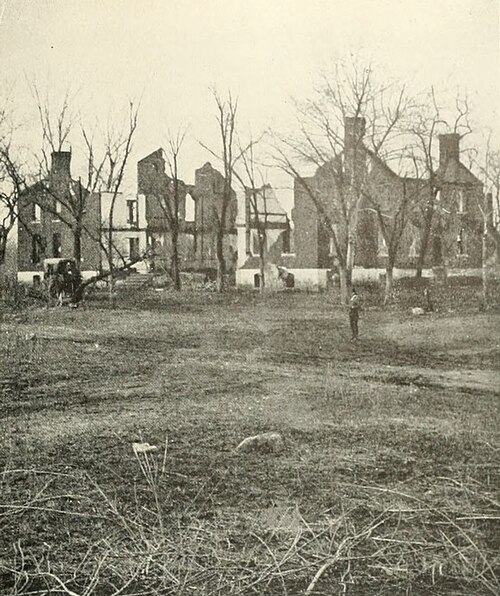
Wednesday, May 6th, 1863. Having started their movement late on the 5th (circa 11PM), the Regiment, about 6 AM on the 6th, recrossed the Rappahannock at US Ford. They made their dispirited way back along familiar roads on the north bank of the river, and ultimately returned to their old camp near Falmouth. There they remained until May 22nd, performing guard and picket duty.
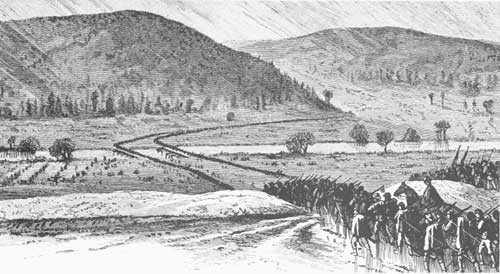
Much of the movement on the night of the 5th through the early morning of the 6th, was done in the rain, and on new roads cut through the Virginia woods. The heavy rain caused the river to rise, and the steadfastness of the pontoon bridges were in question. Peter Welsh describes this retrograde movement (in a letter to his wife on May 7th) as “…another grand scadadle” (SIC) and that the roads, following a thunderstorm overnight, “…were in an awfull (SIC) state…the mud was nearly knee deep and what was worse the most of the men had nothing to eat.” (Welsh, p 90-91)
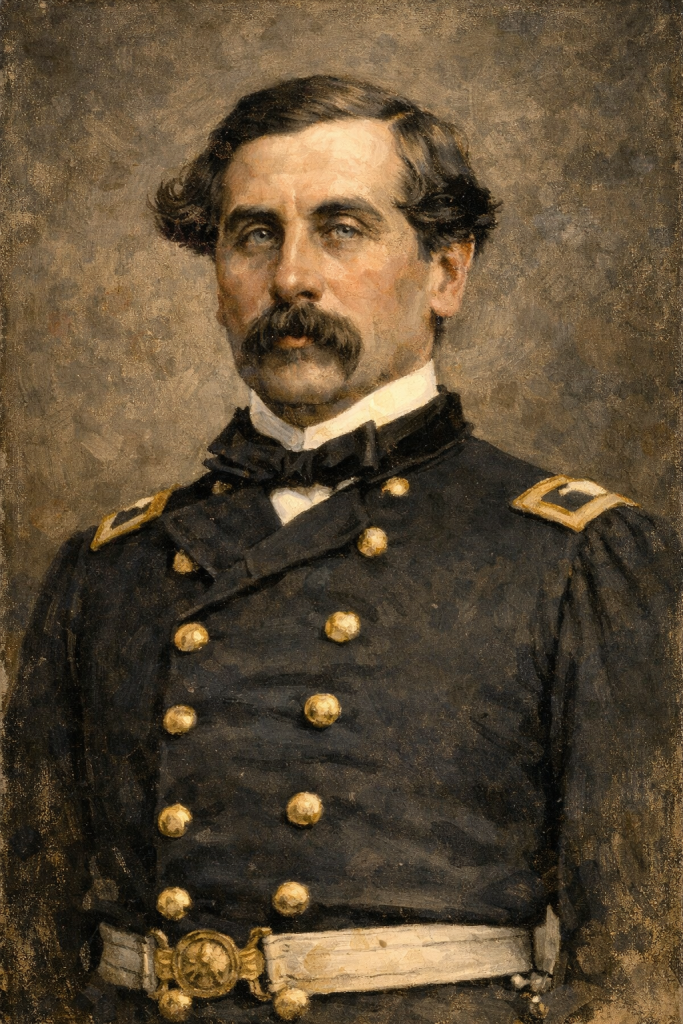
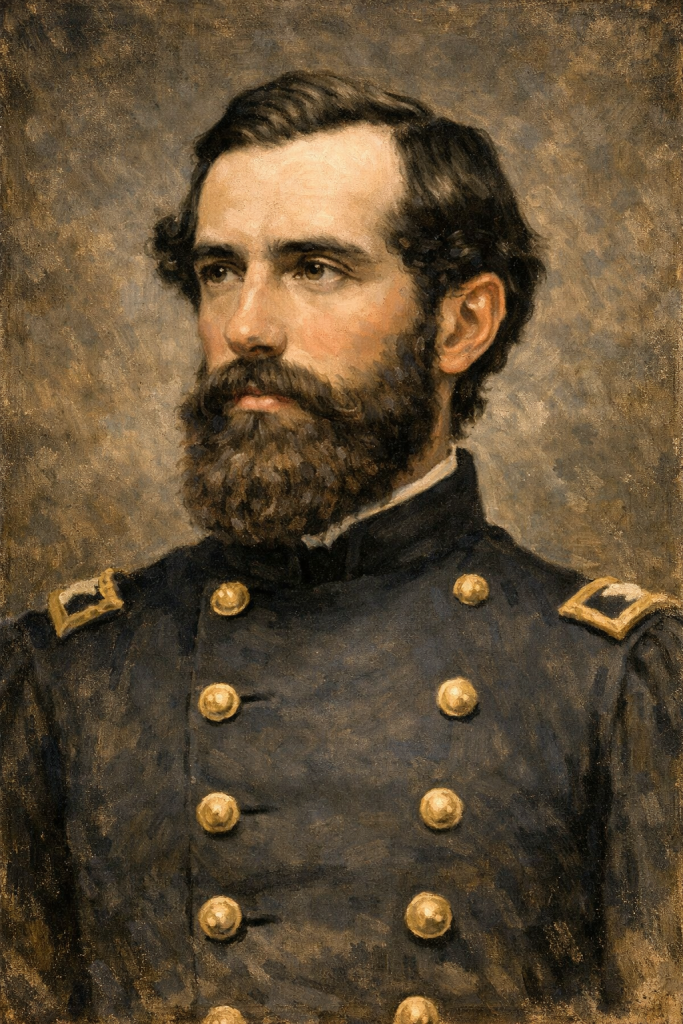
Thursday, May 14th, 1863. Irish Brigade Commander Brig Gen’l Meagher resigns his commission, upset that the he was not given permission to return to New York to recruit replacements for the Brigade. By Wednesday, May 20th, Meagher’s resignation is accepted and he is not given a new assignment. His departure is regretted both amongst his officers and senior NCOs, who pen him praiseworthy departure messages. The Irish -American community is likewise appalled and editorials appear in Irish newspapers decrying his departure. But the founder of the Irish Brigade is gone from the Army, never to lead Irish soldiers forward again.
41-year old Colonel Patrick L. Kelly of the 88th New York, born in Galway, took command of the Irish Brigade in Meagher’s place. Kelly had led the Brigade in Meagher’s absence for much of the period between the Fredericksburg and Chancellorsville battles, so he was the logical men to step up. He would die leading the Brigade during the Siege of Petersburg 13 months later.
Sources: Wylie, 190-194 Egan “Immortal Irishman”, p,250.
Friday, May 22nd, 1863. Left camp and marched towards Falmouth, encamped there until 13 June. (Ryan, p 91)
Sunday, May 31st, 1863. The monthly report: Field/Staff – 8; Co A – 0/35; Co B – 1/28; Co C – 2/32; Co D – 1/35; Co E – 1/28; Co F – 2/28; Co G – 1/25; Co H – 2/24; Co I – 1/31; Co K – 2/29
Total Present – 21/299 Total Present and absent – 28/463 Gain – 6, Loss 31
The Gettysburg Campaign
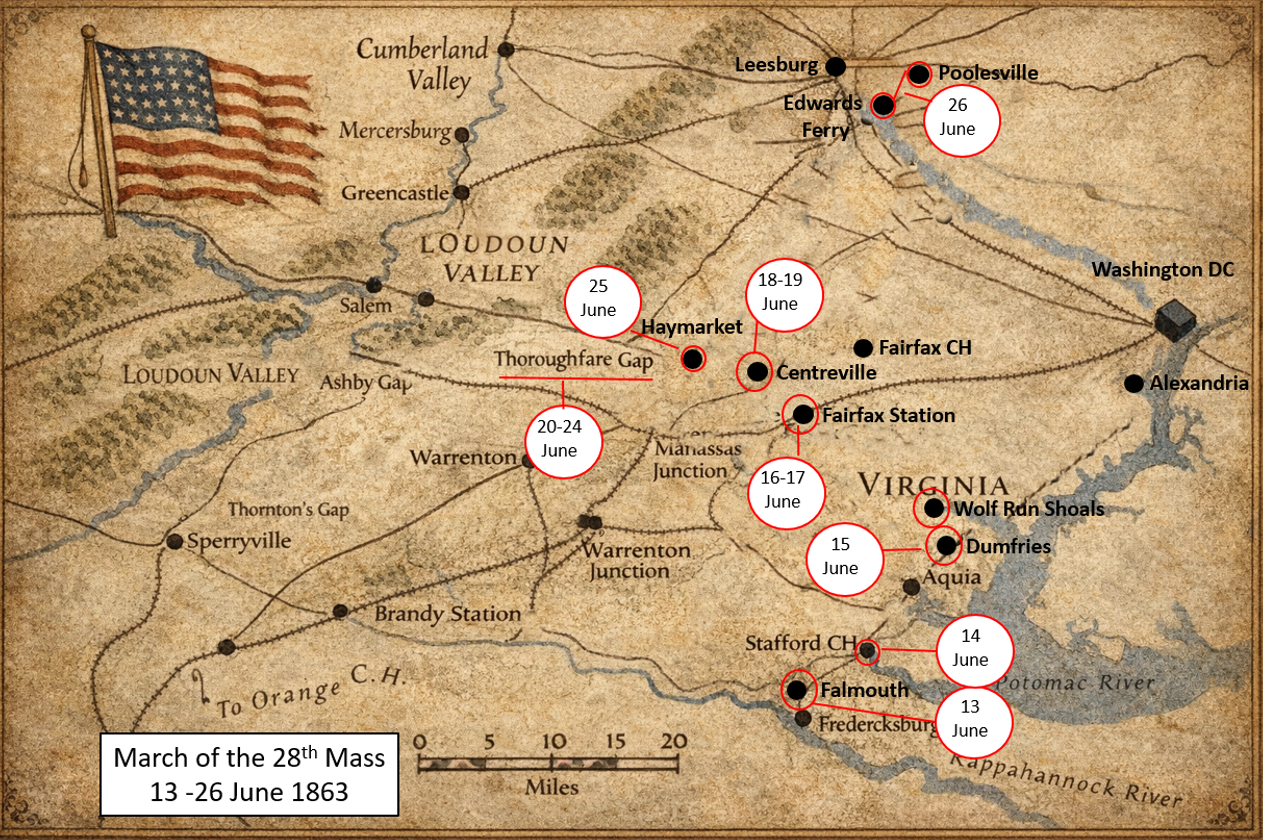
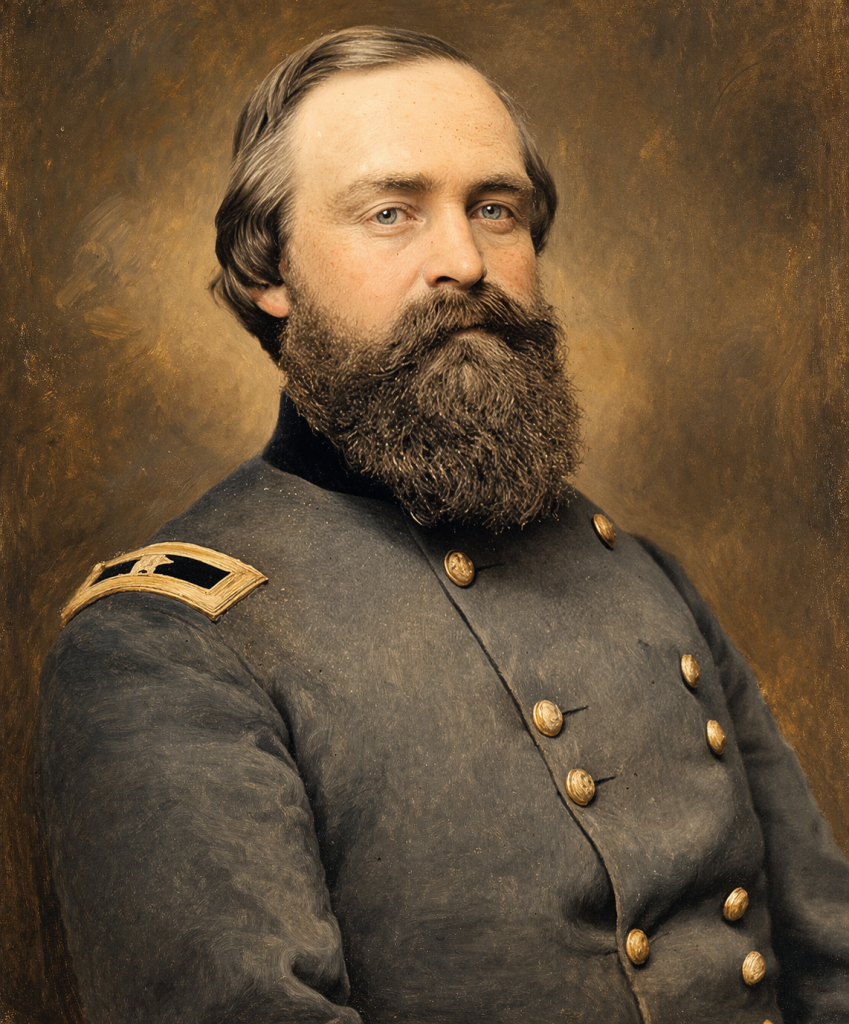
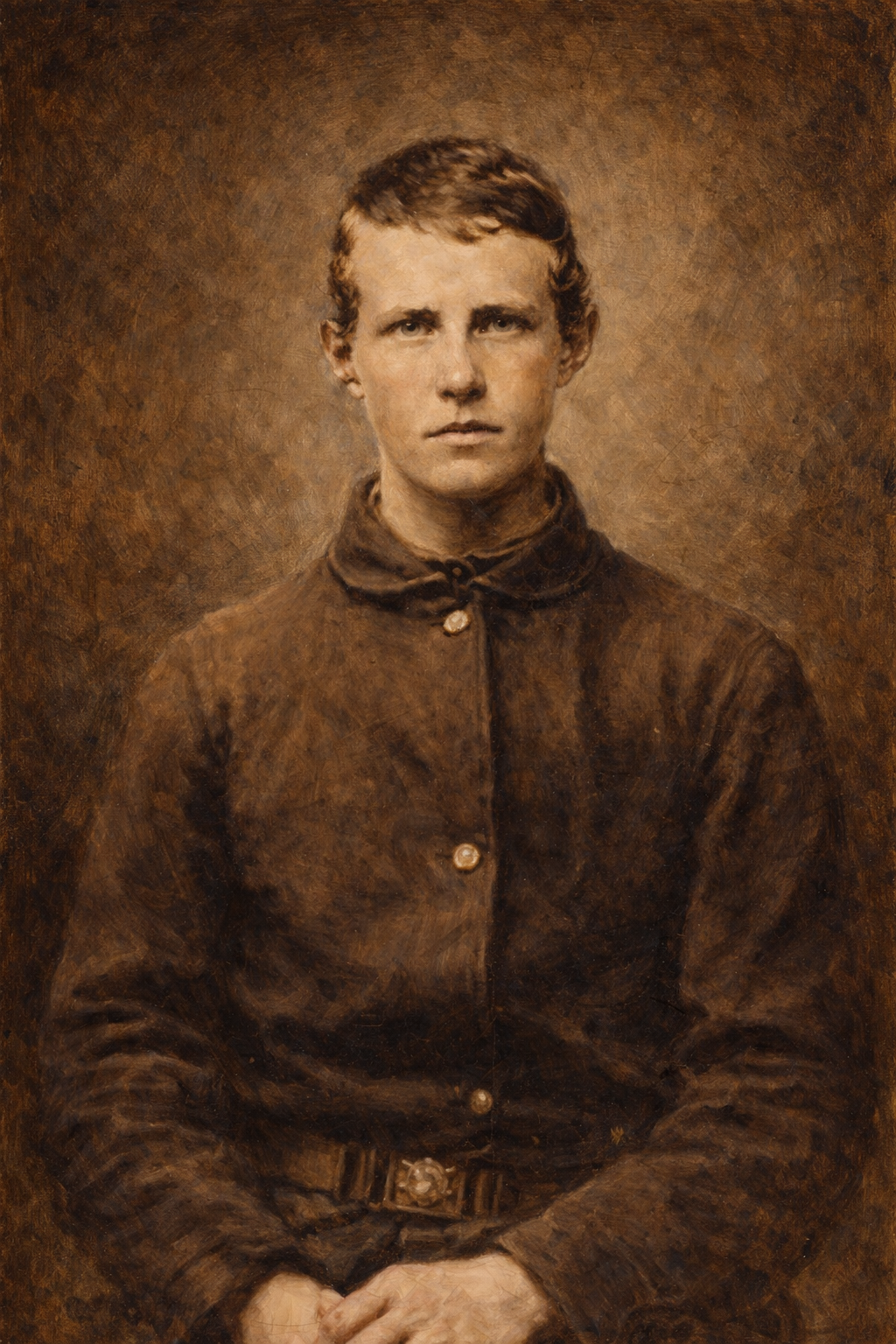
Saturday, June 13th, 1863 – 1st Day on Campaign. On Saturday 13 June 1863, the 28th Massachusetts Volunteer Infantry, 224 strong, is under the command of Colonel Richard Byrnes. The Regiment is assigned to the Second Brigade (the Irish Brigade) (Colonel Patrick Kelly), 1st Division (Brigadier General John C. Caldwell), Second Army Corps (Major General Winfield Scott Hancock), Army of the Potomac (Major General Joseph Hooker). General Hooker has issued orders to have the Army of Potomac move north in pursuit the Confederate Army of Northern Virginia, whose lead elements are near Winchester, VA..
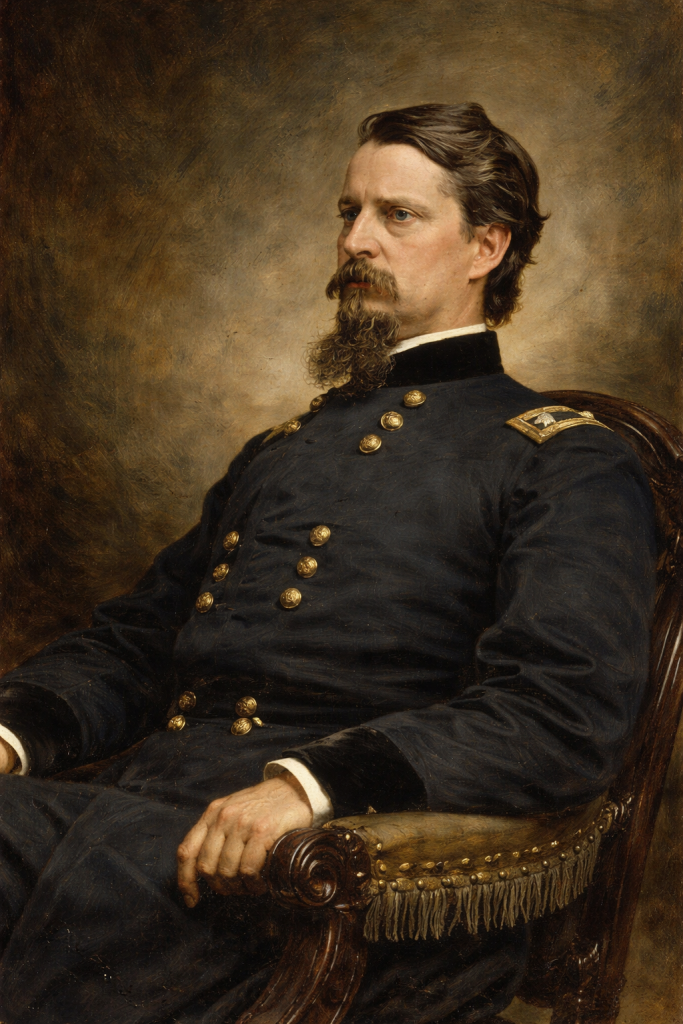
The 28th Mass breaks its camp near Falmouth VA and moves several miles to the Rappahannock River for Picket Duty (at or near Deep Run.) On picket duty, the soldiers of the Regiment experience severe thunderstorms. This concludes the Regiment’s 1st day on Campaign.
Sunday, June 14th, 1863 – 2nd Day on Campaign. Falmouth, VA – Banks of the Rappahannock River.
On Picket Duty until nightfall. Very hot. The Regiment marches after dark. Second Corps is part of what General Hooker labeled his “Second” wing and is moving in close coordination with the Sixth and Twelfth Army Corps as well as the Reserve Artillery. Second Corps is the Rear Guard of the Wing and accordingly, has spent much time rounding up stragglers — plenty to be found in the dry and dusty conditions.
The first day’s march takes the Regiment the short distance to Stafford Courthouse. (The route parallels modern US Route 1 North.)

Total Distance Covered: 8 Miles.
Monday, June 15th, 1863 – 3rd Day on Campaign. Stafford Courthouse, VA to Dumfries, VA – 13 Miles.
The Regiment marched daylight to dusk – likely along the trace of modern US Route 1 – bivouacking in woods near Dumfries. VA. Some accounts indicate Second Corps HQ is located near Aquia Virginia, four miles north of Stafford Courthouse. It is likely Second Corps is strung out along the road between Aquia and Dumfries (a distance of an additional 10 miles.)

Total distance covered since 14 June is 21 miles.
Tuesday June 16th, 1863 – 4th Day on Campaign. Dumfries, VA to Fairfax Station, VA – 21 Miles. One-year anniversary of the Regiment’s first battle (Secessionville.)
The Regiment passes through Dumfries at 0800, turning Northwest across Prince William County to Wolf Run Shoals on the Occoquan River – a point about 10 Miles west of the village of Occoquan. The 28th Mass fords the Occoquan about 7PM. Some soldiers jump in water to cool off, but there are snakes. The Regiment bivouacs near Fairfax Station on the Orange & Alexandria Railroad, (Also known as “Sangster’s Station”), a few miles east of Clifton VA, according to Private John Ryan.)

Total distance covered since 14 June is about 42 miles.
Wednesday, June 17th, 1863 – 5th Day on Campaign. The Regiment remained in camp near Fairfax/Sangster’s Station, VA. Surplus baggage and equipment is collected and sent to storage in Alexandria, VA. The men understand this to be a sign of a coming battle.
Thursday, June 18th, 1863 – Thursday – 6th Day on Campaign. Fairfax/Sangster’s Station, VA to Centreville, VA – 9 Miles.
The Regiment marched at 2PM and encamped in the fortifications at Centreville. Rain & thunder break up the heat

Total distance covered since 14 June is about 51 miles.
Friday, June 19th, 1863 – 7th day on Campaign. The Regiment remained in camp in Centreville, VA.

Saturday, June 20th, 1863 – 8th Day on Campaign. Centreville, VA to the Thoroughfare Gap, VA – 20 miles.
The Regiment marched at midday from its bivouac location in “old fortifications” at Centreville, routing via Groveton, Haymarket, and Gainesville to the Thoroughfare Gap in the Bull Run Mountains. (Just east of present day Marshall, VA, along I-66). The route took the Regiment across the August 1862 2nd Bull Run battlefield. Private John Ryan recounts seeing skeletons exposed by recent hard rains. Roads very bad – wet & muddy. Halted near midnight near the mouth of the Gap after going 20 miles.

Total distance covered since 14 June is about 71 miles.
Sunday – Wednesday, June 21st – 24th, 1863 – Days 9-12 on Campaign. The Regiment spends these days on “Grand Guard” (by practice, called “picket duty,” with the outer sentinels called “pickets”) on the west slope of the Bull Run Mountains at the Thoroughfare Gap. (Just east of present-day Marshall, VA, along I-66). The Regiment’s mission is to “oppose and obstruct the enemy at all hazards.” Private John Ryan recounts seeing Confederate supply trains moving in the distance.

The Grand Guard is a force thrown out in the direction of the enemy to prevent surprise, to give notice of his approach, to delay his advance, and give the main body time to prepare for battle, or make good its retreat. (See August V. Kautz, Customs of Service for Officers of the Army (Philadelphia: J.B. Lippincott & Co., 1865), 36-43.) The Second Corps had this mission on the western flank of the Army of the Potomac as the Army of Potomac moves north in pursuit of the Army of Northern Virginia.
Thursday, June 25th, 1863 – 13th Day on Campaign. Thoroughfare Gap, VA to vicinity of Haymarket, VA – 22 or 23 miles.
The Regiment ends its picket duty in the Thoroughfare Gap and, along with the rest of the Second Corps, gathers itself to move north and close with the rest of the Army of the Potomac. The Regiment moves out in the mid-morning under clear skies between 9AM and 10AM east towards Haymarket, a distance of approximately 18 miles. There is sporadic contact with elements of JEB Stuart’s cavalry who are beginning their ride around the flank of the Army of the Potomac; Company B has 2 men captured –one near the Gap and the other near Haymarket. The presence of large Federal forces on the eastern side of the Gap causes Stuart to veer south and further east than intended, which will keep Lee blind to the movements of the Army of Potomac’s movements for a longer period, to the benefit of the AoP.

Private John Ryan recalls that the Regiment bivouacs at “Green Springs”; Sergeant Peter Welsh recounts it in a letter to his wife as “Pleasant Valley.” I haven’t been able to locate either place on modern maps but I presume that they are likely no more than 5 miles North or East of Haymarket. I reach this conclusion by working backwards from Edwards Ferry, the locale the regiment reaches the following day in the afternoon, after an early start. Given that it is approximately 27 miles from Haymarket to Edwards Ferry, deducting 5 miles and adding that distance to the march of 25 June, takes each day’s average to the 22 or 23 mile range.
With this estimate in mind, the total distance covered since 14 June is about 93 miles.
Friday, June 26th, 1863 – 14th Day on Campaign. Vicinity of Haymarket, VA to Poolesville, MD – 22 Miles
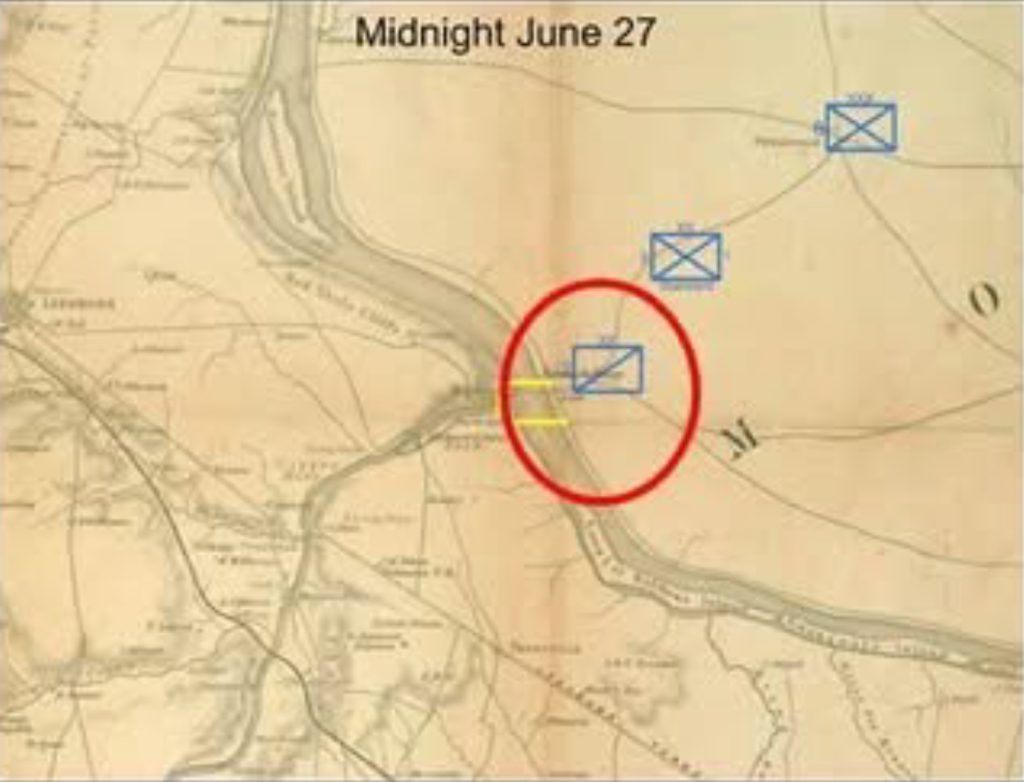
The Regiment is six days from its test of arms in the Wheatfield. Making an early start (First light approximately 0405, Dawn 0435) the Regiment moves approximately 22 miles (as per previous post) via Sudley Springs and Gum Springs (modern Arcola, VA) to Edwards Ferry on the Potomac River, just east of Leesburg, VA.


A cold rain falls, making roads muddy, but the Regiment arrives in the afternoon and goes into camp about a mile short of the crowded crossing point, to await its turn.
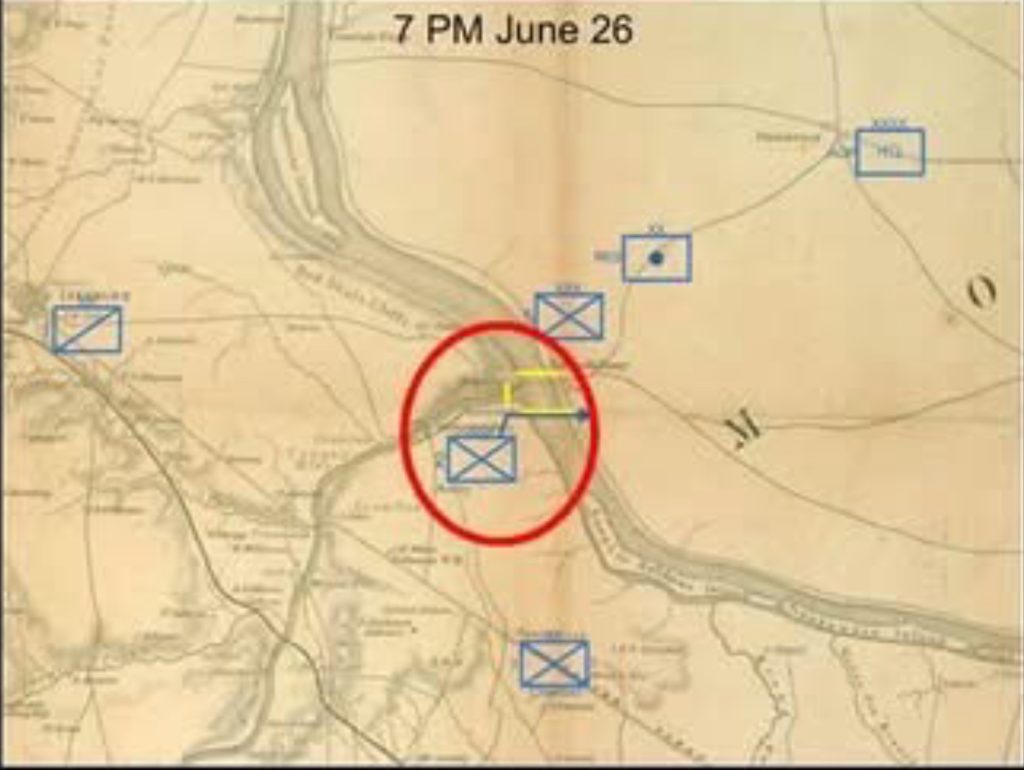
At dark (at bit after 8PM) the Regiment breaks camp, crossing the lower pontoon bridge over the river between 10PM (Ryan) & Midnight (Welsh). On the Maryland side, the Regiment proceeds about 2 miles in the direction of Poolesville, where, short of Poolesville, it rests.
Total distance covered since 14 June is about 115 miles.
For more on the movement of the Second Corps across Loudoun County, VA, see this post from the “To the Sound of the Guns” Blog – the source of the maps associated with this post.
NOTE – 26 June 2025: Craig Swain’s “To the Sound of the Guns” blog has apparently been retired. That said, an archival copy can be accessed at this link.
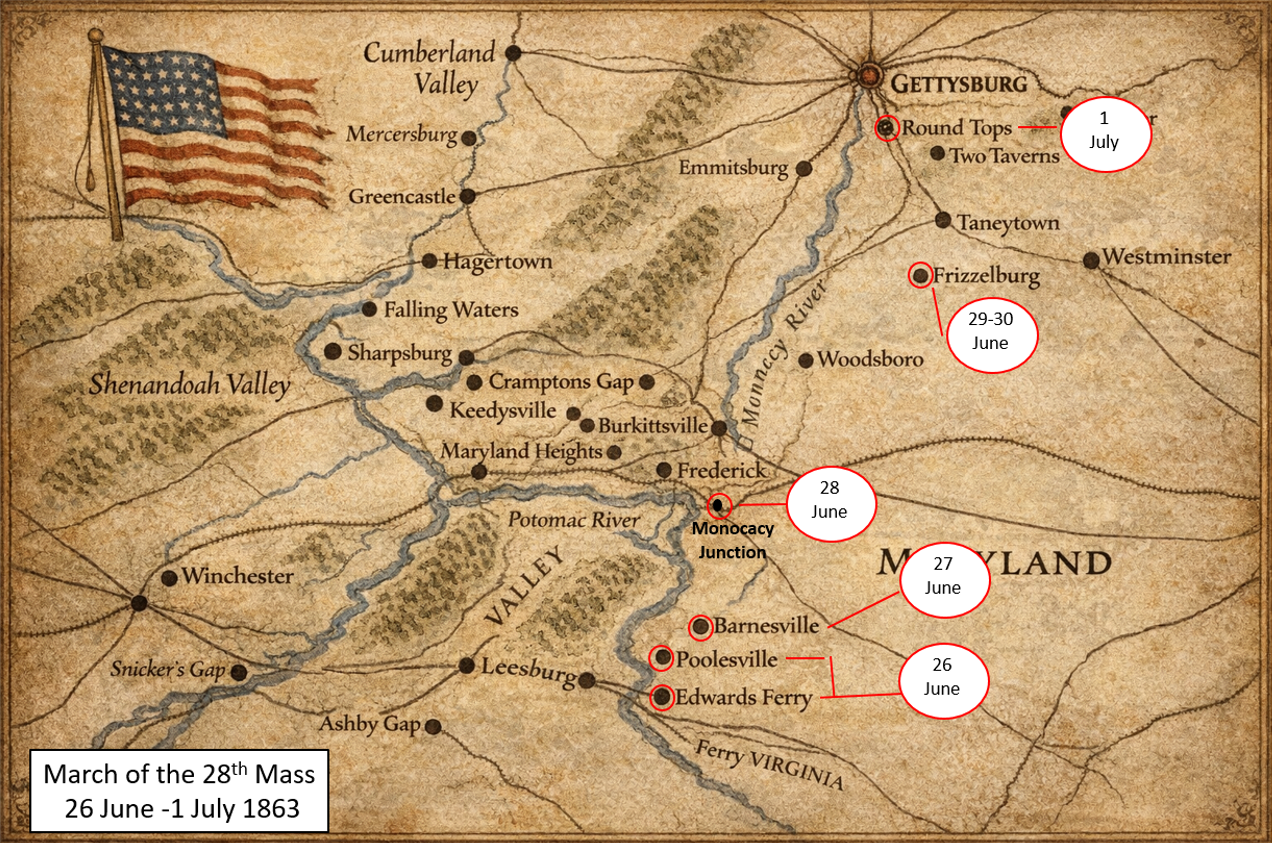
Saturday, June 27th, 1863 -15th Day on Campaign. Poolesville MD to Barnesville, MD – 7 Miles.
Weather: AM Showers, but clear later. The 28th Mass marched at 4PM through Poolesville, arriving at its night bivouac at Barnesville, MD between 11PM and 12 AM. (Ryan calls location “Brownsville.”) Route most likely along the today’s MD Route 109. Distance about 7 Miles; reported elapsed time indicates a very slow movement, no doubt the fact that the entire Second Corps (11,350 men, 28 guns, and Supply train) were likely moving along this route a factor. (The OR notes in its “Itinerary of the Army of the Potomac and co-operating forces, June 5-July 31, 1863” that the Second Corps moved “… from near Edwards Ferry, via Poolesville, to Barnesville, Md.” Presumably, this means that Major General Hancock’s HQ so moved; the bigger picture is that the AoP is gathering itself together as the battle approaches.)

Total distance covered since 14 June is about 122 miles.
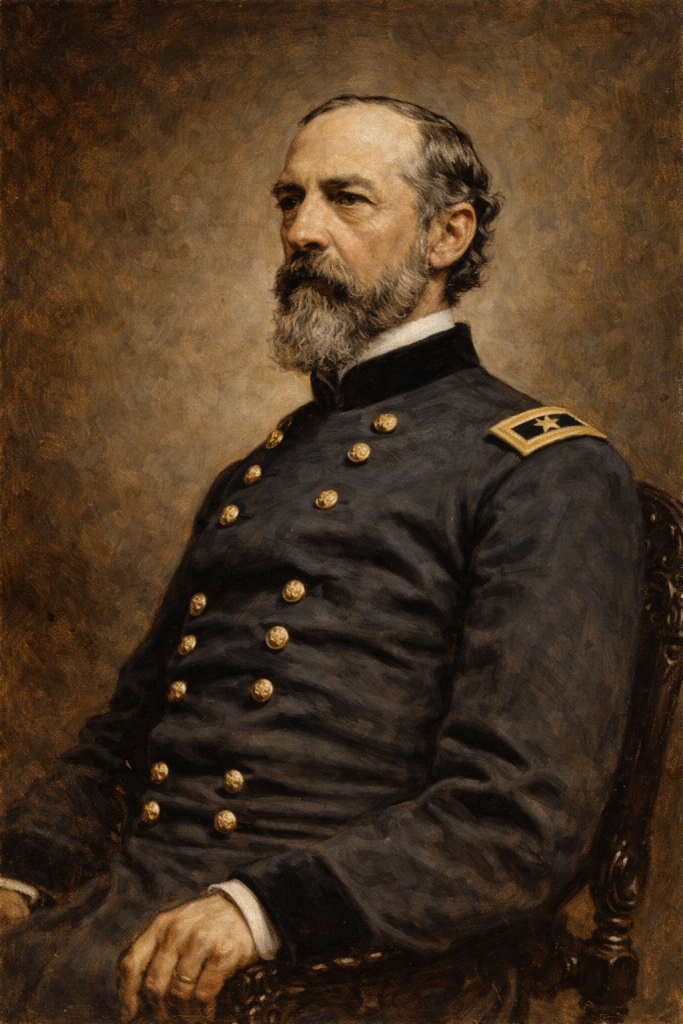
Sunday, June 28th, 1863 – 16th Day on Campaign. Weather: Once again, AM showers, but clear later. The big news this day is that Major General Gordon Meade of Pennsylvania is elevated to the command of the Army or the Potomac, replacing Major General Hooker. Father William Corby, Chaplain of the Irish Brigade’s 88thNY recalls that the change caused great grousing amongst the men about the qualities of generalship, and that some held to the belief that “surely Little Mac” (Major General George B. McClellan) had been placed back in command.

The 28th Mass marched at daybreak (between 0405 and 0435) through West Mills (location unknown) and Urbana MD, crossing what will be the 1864 Monocacy battlefield, and then the Monocacy River, before bivouacking near Monocacy Junction, 3 miles short of Frederick, MD. (Historical note: it was in this area that the famous “Lost Orders” of the Antietam Campaign were found.

This picture (of Brooks Hill on the Monocacy Battlefield) is just west of where the 28th MVI likely camped. It gives a good indication of what the countryside is like.
The day’s march was approximately 15 miles, likely on a route that moved NNE until reaching the Urbana Pike (modern MD route 355.)
Total distance covered since 14 June is about 137 Miles.
Monday, June 29th, 1863 – 17th Day on Campaign. Monocacy Station, MD to vicinity Frizzleburg, MD – 32 miles.
Weather: A drenching rain all day; muddy roads. This day was perhaps the most physically challenging day of the campaign short of actually combat as the Regiment moves 32 miles in miserable conditions, routing through Libertytown, Johnsville, and Uniontown, to a point 2 miles short of Frizzleburg MD.
Father Corby of the 88th NY notes in his memoirs that each soldier carried about 60 pounds “…including his musket, cartridges, provisions, shelter-tent, and blanket.” Sgt. Peter Welsh’s letter to his wife after the battle described that only 40 of the regiment’s 225 men were present with the colors at the end of this exhausting march.
None of the first-person accounts I’ve seen mentions the Regiment marching through Frederick city, so I surmise that the Regiment skirted to the east of Frederick on the north bank of the Monocacy, before following the general trace of the Liberty Road (modern MD route 26) East to Libertytown before veering North to Johnsville and then NNE to Unionbridge along what is now MD route 75. From Unionbridge, the movement likely turned East, through Uniontown to the bivouac site.
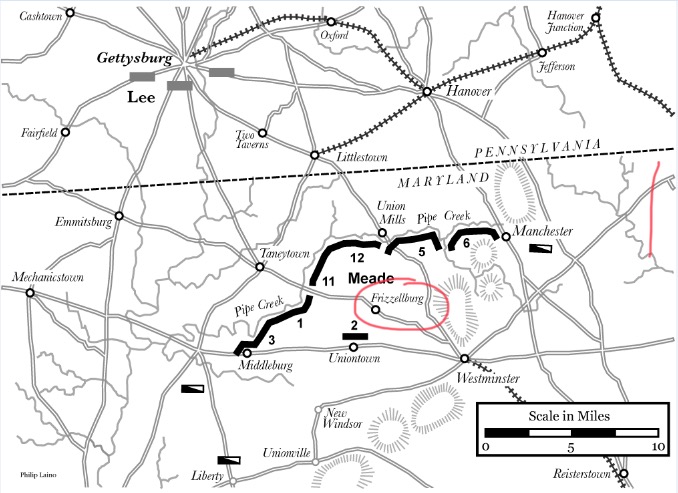
The movement this day takes the Regiment – in fact, the entire II Army Corps – away from the Confederate invaders in Pennsylvania – why? The answer certainly relates to General Meade’s thinking regarding where to force or accept battle with the Army of Northern Virginia. Uncertain of Confederate intentions, and mindful of his orders to ensure he stayed between the Confederates and Baltimore and Washington, he had his engineers scout out possible battle locations that would favor the AoP. These were found along Pipe Creek, Maryland – Frizzleburg is generally in the center of what would become known as Meade’s “Pipe Creek Line.” It is also well located as a road hub. In my judgment, Meade situates the veteran II Army Corps, led by one of the most able Corps Commanders in the Army (and close friend) “Hancock the Superb”, as his Reserve, well positioned operationally to respond to any number of potentialities. Meade comes into much criticism for his “Pipe Creek Circular” of 1 July, but I believe that he is doing what Army commanders must do – that is, thinking ahead several steps in both time and space. (Operational Art)
Total distance covered since 14 June is about 169 miles.
Tuesday, June 30th, 1863 – 18th Day on Campaign. Weather: Light rain early, overcast later. Becoming warmer. Full Moon. The Regiment remains in bivouac near Frizzleburg, MD.

Wednesday, July 1st, 1863 – 19th Day on Campaign. Frizzleburg, MD to vicinity Gettysburg, PA – 19 miles.
First Day of the Battle of Gettysburg. Weather: Light rain early, sunny in afternoon, warm and high humidity. The Regiment moves NNW up the Taneytown Pike, via Taneytown and then likely North through Harney MD (near the PA- MD border) where it moves on the Taneytown road (modern PA route 134) to a point 3 miles short of Gettysburg, where it camps. (This is approximately near the modern US 15 exit for the Taneytown Road.) The Taneytown Road runs North-South along the eastern edge of the eventual Union position along Cemetery Ridge. With the battle begun north and west of Gettysburg, it is likely that the Regiment heard the fighting and knew battle was near.
This day’s movement is approximately 19 miles, bringing the total distance covered since 14 June to about 188 miles.
The Regiment kept up with its paperwork, submitting its monthly report this day: .Field/Staff – 5; Co A – 1/21; Co B – 1/21; Co C – 2/29; Co D – 1/37; Co E – 2/19; Co F – 2/23; Co G – 1/17; Co H – 2/26; Co I – 1/21; Co K – 1/31
Total Present – 18/256 Total Present and absent – 25/457 Gain – 2, Loss 11
Thursday, July 2nd, 1863 – 20th Day on Campaign. 2nd day of the Battle of Gettysburg. Weather: Scattered drizzle early, very warm (Upper 80s) and humid as day progresses. The 28th Massachusetts Volunteer Infantry arrives on the battlefield via the Taneytown Rd at approximately 7AM. The regiment moves to the Center of the Union position on Cemetery Ridge. There, along with the other members of the Irish Brigade, it receives a General Absolution from Father William Corby of the 88th NY:

“Dominus noster Jesus Christus vos absolvat, et ego, auctoritate ipsius, vos absolvo ab omni vinculo, excommunicationis interdicti, in quantum possum et vos indigetis deinde ego absolvo vos, a pecatis vestris, in nomni Patris, et Filii, et Spiritus Sancti, Amen. ” (“Our Lord Jesus Christ absolve you, and I, by his authority, absolve you from every bond, excommunication, interdict, and in so far as I can and then I will absolve you, from your sins, in the name, of the Father, and of the Son, and the Holy Ghost, Amen “)
Following from the tactical implications following from Sickles’ infamous salient, the Regiment in late afternoon is rushed to attack Confederate forces driving Sickles’ Third Army Corps backwards (east) towards Cemetery Ridge. The Regiment, along with the entirety of the 2d Division, pivots and attacks into the flank of Confederate Forces. (See map. Broadly, this movement is south from the Trostle Woods across the Wheatfield and into the Rose Woods and the Stony Hill on the west side of the Wheatfield. (The Regimental monument on the Gettysburg Battlefield is on the Stony Hill.)

The melee in the Wheatfield becomes a legendary slugfest, and although the Second Corps’ Federals initially blunt the Confederate attack, they are eventually driven off by new Confederate forces. Here is the Commander of the Regiment (Colonel Richard Byrnes) official report of the action:
“At 3 p.m., July 2, the order was given to advance, and the regiment proceeded a short distance forward and to the left, and then was ordered back to its original position. Soon after was ordered to move to the left, and about 5.30 o’clock became engaged with the enemy, who were posted in an advantageous position on the crest of a rocky hill. We forced them to retire from this eminence, and advanced over the top and almost to the bottom of the other side of the hill, being all the time exposed to a very severe fire of musketry, and losing many men in killed and wounded.
About 7 p.m., finding all save this regiment were retiring from the hill, and that the enemy were on both our flanks, as well as in front, I brought my command from the field, losing many men from the concentrated fire of the rebels. Our loss in this action was 100 in killed, wounded, and missing, out of 224 taken into the engagement.
I reformed the regiment, and rejoined the brigade near the Second Division hospital about dark, and soon after were moved to the front, where we remained all night.”
Total distance covered since 14 June is about 191 miles.
In the Gettysburg Campaign, the 28th MVI had a total of 107 men killed, wounded or missing. Go mbeadh trócaire ag Dia ar a n-anamacha. (Irish: May God have mercy on their souls.)

Friday & Saturday, July 3rd & 4th, 1863 – 21st & 22nd Days on Campaign. 3rd day of the Battle of Gettysburg. The Regiment remained in position on Cemetery Ridge. Here continues Colonel Byrnes’ official report, picking up from the point where yesterday’s post ended:
“…in the morning erected breastworks of rails and earth, behind which we remained throughout the entire day, during the greater portion of which the enemy kept up an extremely heavy fire of artillery, and made two attempts to force our lines, but were repulsed on each occasion with great loss. On account of being sheltered by our earthworks, which we erected on the 3d instant, we suffered no casualties from the enemy’s fire.”
Additionally on July 3rd, the command of Second Corps changed twice. Following the wounding of Corps Commander Maj Gen’l Winfield Hancock, temporary command of the Second Corps went to Brig Gen’l John Caldwell (the Irish Brigade’s Division Commander.) Later that evening, after Pickett’s charge was repulsed, command of the Corps was entrusted to 44-year old Brig Gen’l William Hays, although Hays was junior in seniority to Caldwell. (Potentially this was due to Hays being a West Pointer and a Regular Army professional, as well as being older than the 30-year old Caldwell, a pre-war school principal.
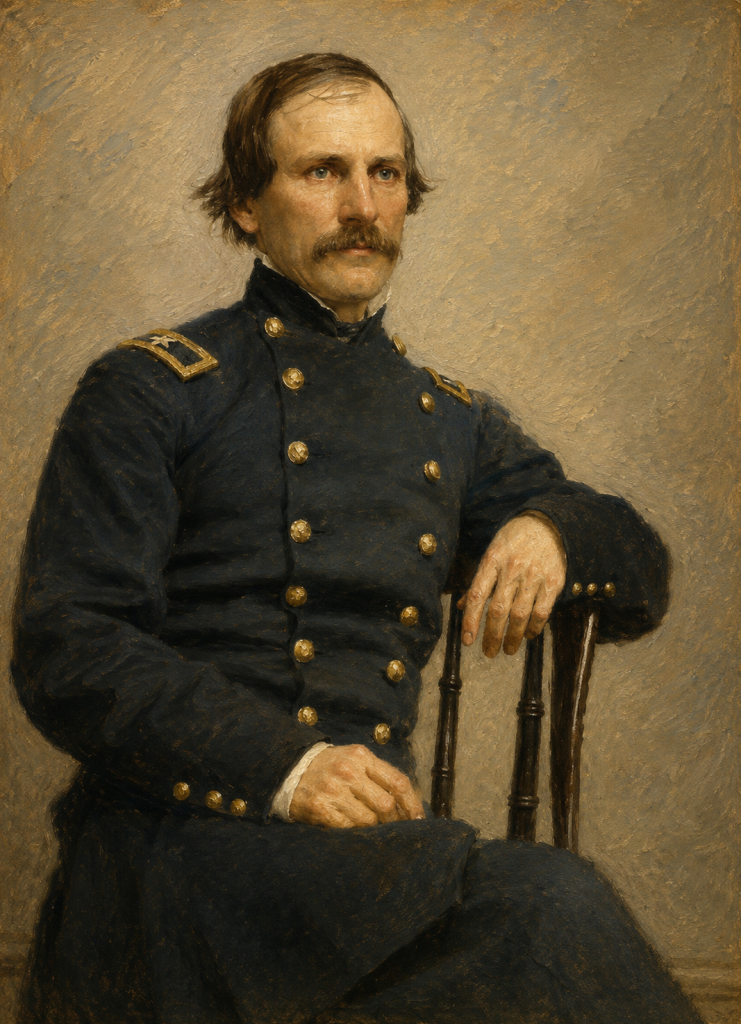
Hays was an 1840 USMA graduate and therefore a classmate of more famous Civil War Generals William T. Sherman, George Thomas, and Richard Ewell (CSA). As a Brigade Commander at the Battle of Chancellorsville, he was wounded and captured on May 3rd, 1863 but subsequently exchanged on May 15th. He had accompanied the Second Corps on its march north and was in position to be assigned. He would command the Second Corps until August, when command of the Second Corps was given to Maj Gen’l Gouverneur K. Warren.
The Pursuit after Gettysburg
Famously, the Army of Potomac has been labeled sluggish in its pursuit of the retreating Army of Northern Virginia. In some regards this is fair, but after suffering approximately 23,055 casualties (3,155 killed, 14,531 wounded, 5,369 captured or missing), it is likewise understandable. The 28th Mass would participate in the pursuit, as would be detailed below. As on its march north, the Army of the Potomac moved on interior lines and kept itself between the Confederates and major east coast cities (Philadelphia, Baltimore, and most importantly, Washington DC.)
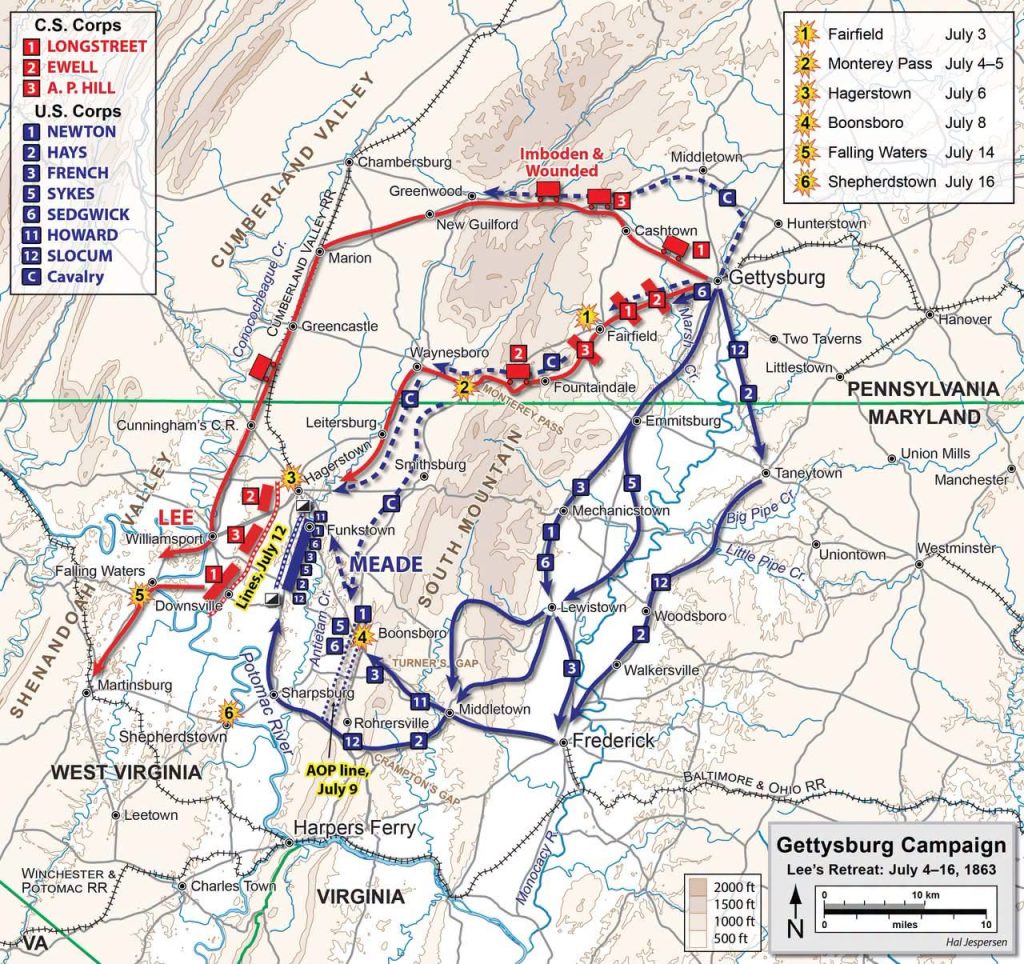
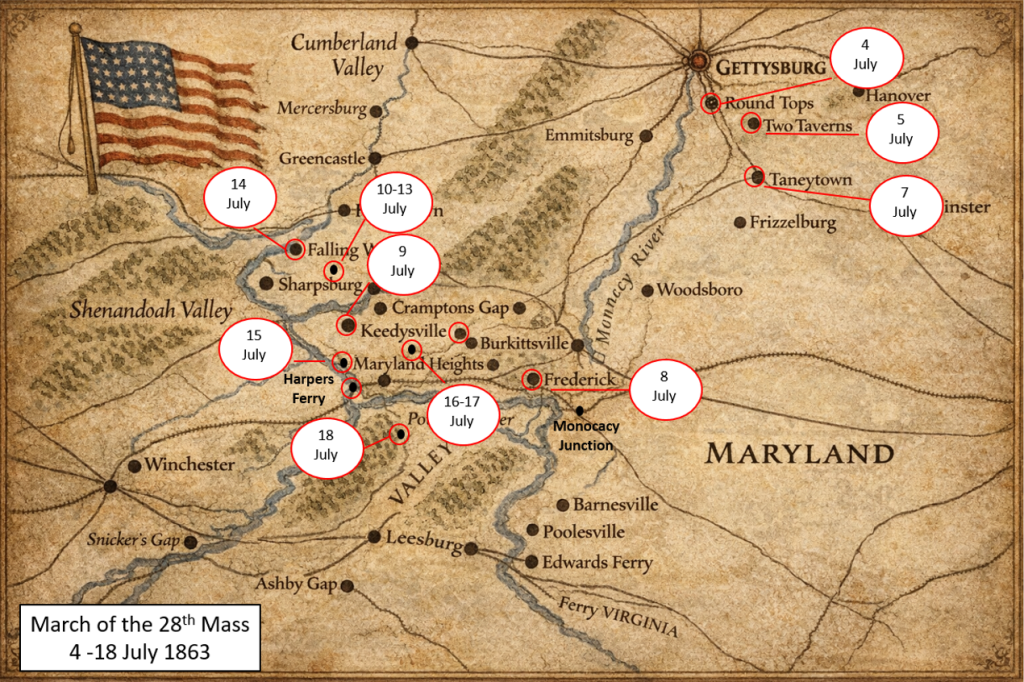
Sunday, July 5th, 1863. 23rd Day on Campaign. As the Army of Potomac began to pursue the retreating Confederates, the 28th Mass left its position on Cemetery Ridge, and marched approximately 4 miles SSE along the Baltimore Pike to the vicinity of a small locality known as Two Taverns. There they would remain until July 7th.
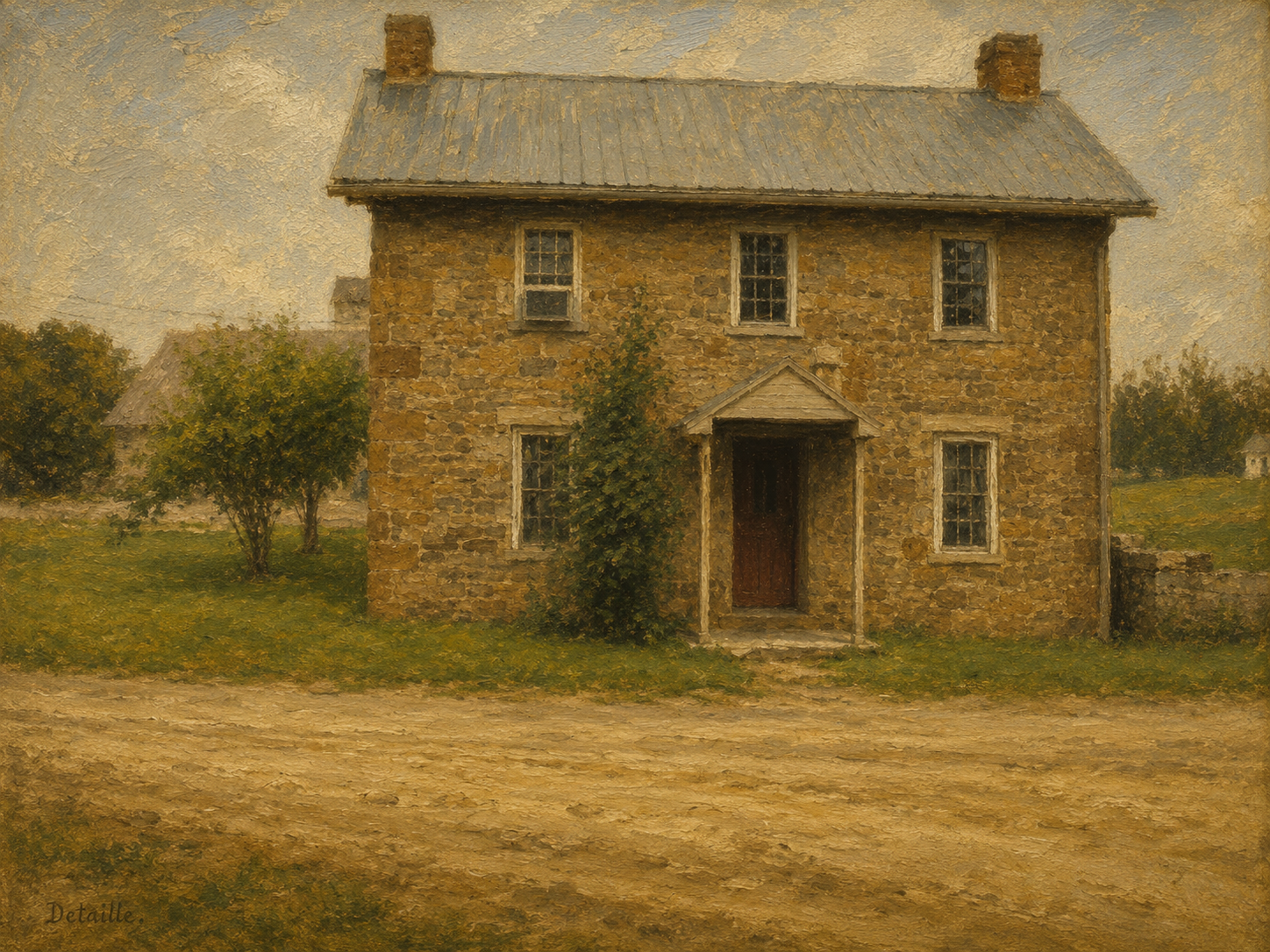
Monday, July 6th, 1863. 24th day on campaign. Peter Welsh writes his wife a short note to say he was safe and unhurt after a “terrifick” battle,” writing her for the first time since 18 June (near Fairfax Station) . Location “5 miles from Gettysburg.”
Tuesday, July 7th, 1863. 25th day on campaign. This day saw the Regiment on a long march, first to Tawneytown MD, then on through Woodsboro to a spot 5 miles short of Frederick, MD – distance of 20 miles. Heavy rain throughout the day on Tuesday. Rested on the 8th.
Thursday, July 9th, 1863. 27th day on campaign. Marched at 5AM through Frederick MD to Burkittsville MD, a distance of 18 miles. Then moved through Crampton’s Gap, 6 more miles, before encamping for the night, near Keedysville, Md.
Saturday, July 10th, 1863. 28th day on campaign. More marching – stepping off at 7AM from Keedysville, MD to Jones Cross Roads – 14 miles. Camped there until 2PM 12 July.
Sunday, July 12th, 1863. 30th day on campaign. At 2PM, moved about a half-mile from their previous position, and entrenched to the right of Jones Cross Roads. Severe thunderstorm that evening.
Tuesday, July 14th, 1863. 32nd Day on campaign. Marched at 8AM forward in line of battle towards Falling Waters and camped for the night. Peter Welsh says “Williamsport” (not Falling Waters) and that the enemy had left.” (PW 112) The Regiment supported the Calvary and helped capture a number of prisoners. (Welsh says 2000 prisoners, actual number was around 800).
Wednesday, July 15th, 1863. 33rd day on campaign. – Left at 0630 and marched through Sharpsburg and the Antietam battlefield and to within 2 miles of Harper’s Ferry where the Regiment camped for the night on the tow path.
Thursday, July 16th, 1863. 34th day on campaign. Marched past Harper’s Ferry to Sandy Hook and then on to Pleasant Valley – six miles. This date was also the Regiment’s one-year anniversary of arriving at Fort Monroe after its brief employment in the Carolinas.
Friday, July 17th, 1863. 35th day on campaign. Peter Welsh sends his wife Margaret a long letter from Pleasant Valley where he describes his experiences in the Gettysburg Campaign and battle, catching her up,from his last long letter mid-June. In his letter he shows awareness of the “disgraceful” Draft Riots in NYC (13-16 July) which he had read about in a newspaper the day before. (PW 108-110)
Saturday July 18th, 1863. 36th day on campaign. At 5AM, marched through Harper’s Ferry and crossed into Virginia; camping 5 miles into Loudon Valley after moving 10 miles that day.
Sunday July 19th, 1863. 37th day on campaign. Marched at 11AM, marched through Snicker’s Gap, and camped after moving about 8 miles this day.

Monday, 20 July 20th, 1863. 38th day on campaign. Marched at 7AM, covered 14 miles, camping a mile from Bloomfield, VA.
Wednesday, 22 July 22nd, 1863. 40th day on campaign. Marched at 7AM and marched towards Ashby’s Gap, camping in the Gap, after covering 10 miles.
Thursday, July 23rd, 1863. 41st day on campaign. Marched towards Manassas Gap, halting 2 miles short of the Gap. About 5PM, resumed the march, going 5 miles into the Gap before camping.
Friday July 24th, 1863. 42nd day on campaign. Marched at 11AM, moved 10 miles to Markham VA. (July 24th 1863 considered the official end date for the Gettysburg Campaign.)
End of the Gettysburg Campaign
Saturday, July 25th, 1863. Marched 22 miles from Markham (Fauquier County) VA to White Plains, VA.
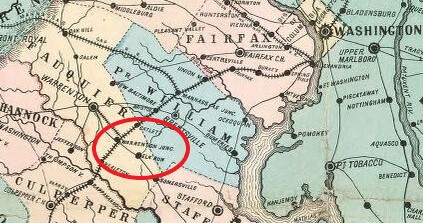
Sunday, July 26th, 1863. Marched 20 miles through Warrenton camping within 4 miles of Warrenton Junction (a stop on the Orange & Alexandria railroad line) . Stayed there until 30 July
Thursday, July 30th, 1863. Moved towards Elk Run and camped.

Friday, July 31st, 1863. Marched towards Morrisville, camping in an ”adjacent wood” 5 miles short of Kelly’s Ford and crossed the Rappahannock River.
Saturday, August 1st, 1863. Monthly Report: Field/Staff – 6; Co A – 1/18; Co B – 1/14; Co C – 2/16; Co D – 1/12; Co E – 0/9; Co F – 1/16; Co G – 1/11; Co H – 2/13; Co I – 0/14; Co K – 0/16
Total Present – 15/143 Total Present and absent – 448 Gain – 2, Loss 36. (Compare the “Present” number above to the July 1st report (on the eve of the fight in the Wheatfield) of 18 officers and 256 soldiers present.)
Sunday, August 2nd, 1863. Colonel Byrnes submits his official report of the Regiment during the Battle of Gettysburg. Sergeant Peter Welsh writes his wife Margaret a short note from “Near Kelly’s Ford.” Weather very hot but they are camped in the shade of a wood. Welsh notes that the Regiment had received some draftees as replacements and doubled down on his displeasure that Irish people had participated in the NYC riots.
Wednesday, August 5th, 1863. The Regiment moved two miles to “another locality” and stayed until 22 August.
Monday August 10th, 1863. Ever-faithful correspondent Peter Welsh writes his wife from near “Morrisvill” VA. (Modern “Morrisviile” – about 22 miles west of Fredericksburg along modern Us 17.) In his letter he tells Margaret that there “isn’t any prospect of fighting.” (PW 117) He writes her again on the 21st.
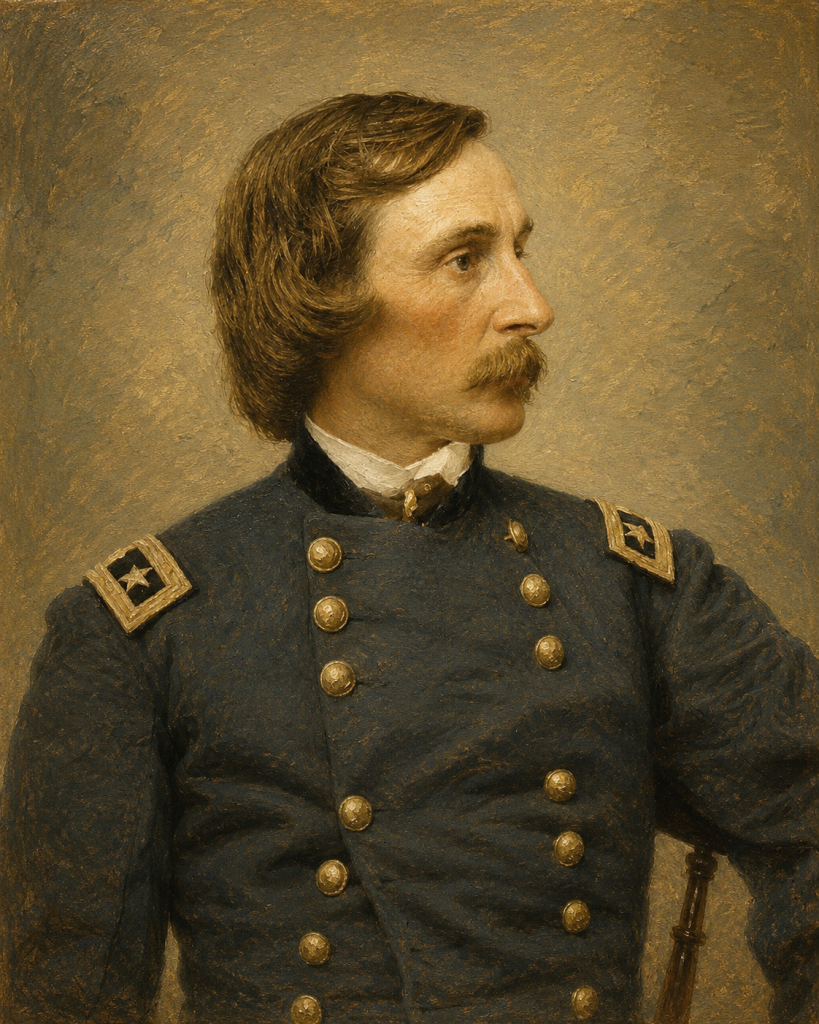
Wednesday, August 12th, 1863. Newly promoted (August 8th) 33-year old Maj Gen’l Gouverneur K. Warren assumed command of the Second Corps, replacing Brig Gen’l Hays. Warren, as the Chief Engineer of the Army of the Potomac, famously recognized the importance of Little Round Top during the Battle of Gettysburg and his actions saved the Federal line. He would command the Second Corps until Maj Gen’l Hancock recovered from his Gettysburg wounds, ultimately commanding the Fifth Corps in the Overland Campaign of 1864.
Saturday, August 22nd, 1863. The Irish moved camps – about a half a mile – and stayed end of August..
Friday August 28th, 1863. In camp near Morrisville, Peter Welsh writes his wife Margaret to thank her for a box she had sent – it had been searched for liquor but everything came through (PW 121)
Monday, August 31st, 1863. The 28th Mass moved with entire Brigade in the direction of Falmouth, near Fredericksburg. Later that afternoon, back-tracked towards US Ford, passing Grove and Hartwood Church in Stafford County , arriving about 6PM, and camped. The monthly return was also submitted this day – the gain of 184 soldiers certainly the draftees mentioned by Peter Welsh in his letter home of August 2nd.
Monthly Report of August 31st, 1863: Field/Staff – 4; Co A – 1/33; Co B – 1/30; Co C – 2/29; Co D – 1/30; Co E – 0/31; Co F – 1/32; Co G – 0/34; Co H – 2/30; Co I – 0/28; Co K – 0/34
Total Present – 12/314 Total Present and absent – 22/561 Gain – 184, Loss 27

Friday, September 4th, 1863. Marched back to their original encampment near Morrisville.
Wednesday September 9th, 1863. Near Morrisville – Peter Welsh wrote his wife Margaret mentioning that the Regiment had just spent 5 days on picket duty near US Ford.
Saturday, September 12th, 1863. Marched at 8AM, moving 9 miles towards Rappahannock Station. Intense heat, slow march, many stragglers (even the best men), numerous halts. At 4PM an “extraordinary rain” fell, saturating everything and everyone. Slept on the ground in some woods, keeping a strong guard as there was some action to the front involving Buford’s US Cavalry.
Sunday, September 13th, 1863. Marched at 8AM, marching towards Culpeper, crossing the Rappahannock River, staying in supporting distance of the US calvary, camping within 3 miles of Culpeper, after covering 12 miles.
Tuesday, September 15th, 1863. Marched at 2 PM, moving through Culpeper, passing Cedar Mountain (on the right) and encamping to the left of the road leading to the crossing of the Rapidan, camping about 2 miles short of the river.
Wednesday, September 16th, 1863. Under arms from 7AM to Noon, the 28th was prepared to move, but never were ordered to do so – so they went back to their camp.
Thursday, September 17th, 1863. Marched to near Rapidan Station. (On the 25th, Peter Welsh reports that they had been there 8 days.
Saturday September 19th, 1863. Took up “guard and picket duty” on the Rapidan, performing this duty until 6 Oct. Peter Welsh writes Margaret a chatty letter from “near Culpeper” and has a discussion with her about him not sending pay home during the Gettysburg Campaign. (PW 124-125)
Friday September 25th, 1863. Peter Welsh writes his wife from “In camp near Rapidan Station” reporting that he had received two months of back pay (~$26) and had sent her $20 -,with the promise of $30 to come after the next payday, as he was getting paid as a Sergeant since September 1st. (A pay jump,from $13 to $17 monthly.) He reports that they had picket duty at the River 3very 4th day. (PW 126)
Wednesday, September 30th, 1863. Monthly Report: Field/Staff – 5; Co A – 1/29; Co B – 1/28; Co C – 2/24; Co D – 1/28; Co E – 0/24; Co F – 1/28; Co G – 0/29; Co H – 2/24; Co I – 0/25; Co K – 0/31
Total Present – 13/274 Total Present and absent – 20/528 Gain – 18, Loss 53
Tuesday October 6th, 1863. Marched north through Culpeper, camping three miles past it, after covering 10 miles.
Wednesday October 7th, 1863. Peter Welsh writes his wife from “In camp near Brandy Station.” In his letter he tells his wife that Father Corby of the 88th NY is “continually with us.” Corby was the only Catholic chaplain with the Irish Brigade for significant stretches of time.(PW 128-129)
Friday October 9th, 1863. Marched back thru Culpeper, towards the Rapidan, halting 1 mile on the southwest side for an hour, them made a retrograde movement , marching past Brandy Station, crossing the Rappahannock, and camping near Bealton station, a total of about 15 miles.
Monday, October 12th, 1863. Marched to Rappahannock Station – 4 Miles. halted fro an hour and then crossed the Rappahannock . River “with the rest of the Corps.” Formed line of battle and moved in support of the Calvary towards Brandy Station. Halted at 5PM and remained in place until 10 PM, then again crossed the Rappahannock, marching past Rappahannock Station, Bealton and Fayettesville, reaching the later circa 5 AM on 13 October.
NOTE: Fayettesville is just short of Opal on modern US 17. Warrenton Junction was east of Warrenton and was a station on the Orange & Alexandria R.R. It was SW of Catlet Station.
Bristoe Campaign
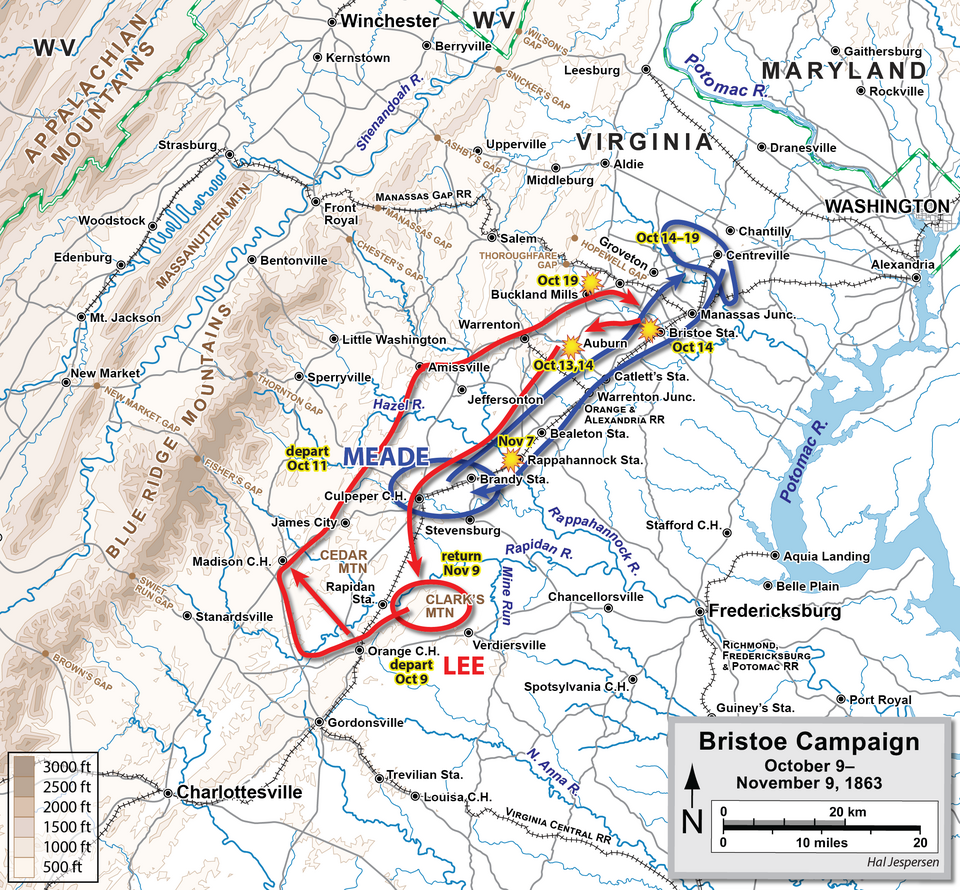
Tuesday, October 13th, 1863. Reached Fayettesville, VA circa 5AM, rested 2 hours, then marched in the direction of Warrenton Junction. Three miles short of Warrenton Junction, the march turned towards Auburn, where they arrived circa 8PM and camped in a wood.
2nd Battle of Auburn/Battle of Bristoe Station
Wednesday, October 14th, 1863 found the 28th Mass encamped with their Division a few miles south of Auburn, Virginia – the site of a small mill on Cedar Run – a location several miles west of Catlett’s Station on the old Orange & Alexandria Railroad. The Division had set out north towards Auburn the day prior (the 13th) from Fayettesville VA (near modern-day Opal) and had encamped that night in a wood, as stated, about 2 miles short of Auburn.
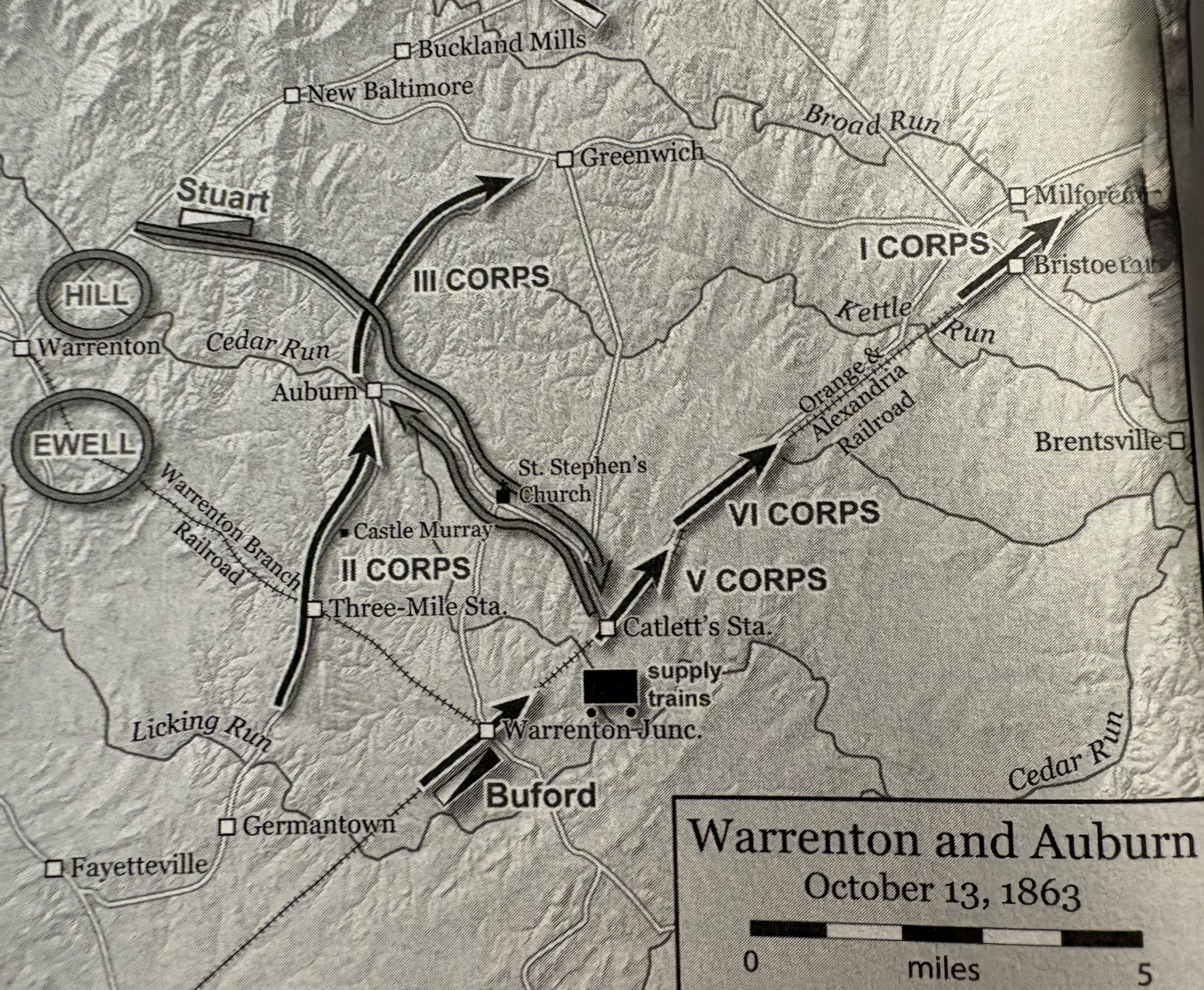
The Regiment was roused at 4AM on the 14th, in order to continue their movement on a country lane north towards Auburn. (See map). They moved for roughly two hours, crossed Cedar Run, and climbed a small hill to the rear of a small farmhouse. Halted, the column was shaken out into a line of battle and the men were ordered to make a quick breakfast – likely a series of small fires sprung up along the line to make coffee, and perhaps fry up a bit of bacon – typical march fare.
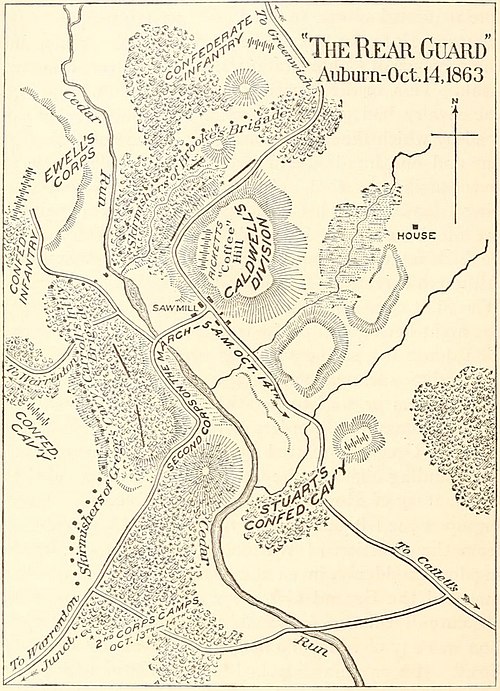
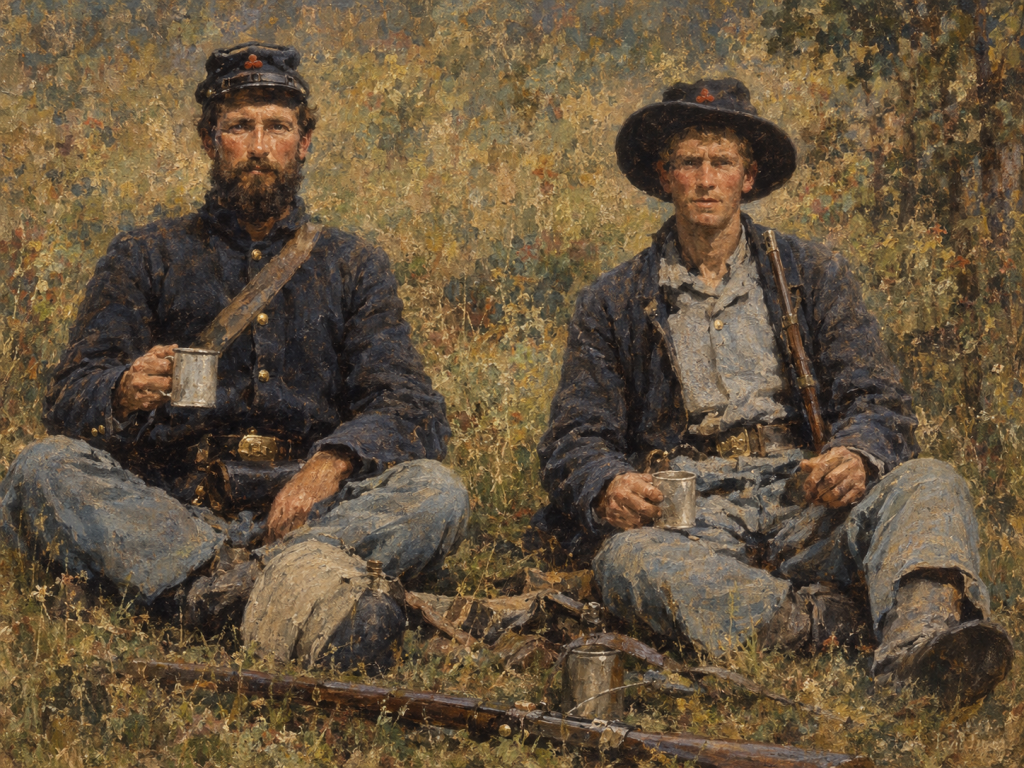
About 6:15AM, the quiet of the morning was disrupted by the bang of artillery and the screaming of shot overhead. Confederate Horse Artillery from Stuart’s Calvary had taken the breakfasting men of Caldwell’s Division under fire from the east.
One can imagine the soldiers scrambling for cover but most of the shot passed overhead. The fire lasted about an hour and 28th had one soldier killed. John Ryan described the incident in his memoir while Peter Welsh fails to mention it at all in a letter to his wife several days later.
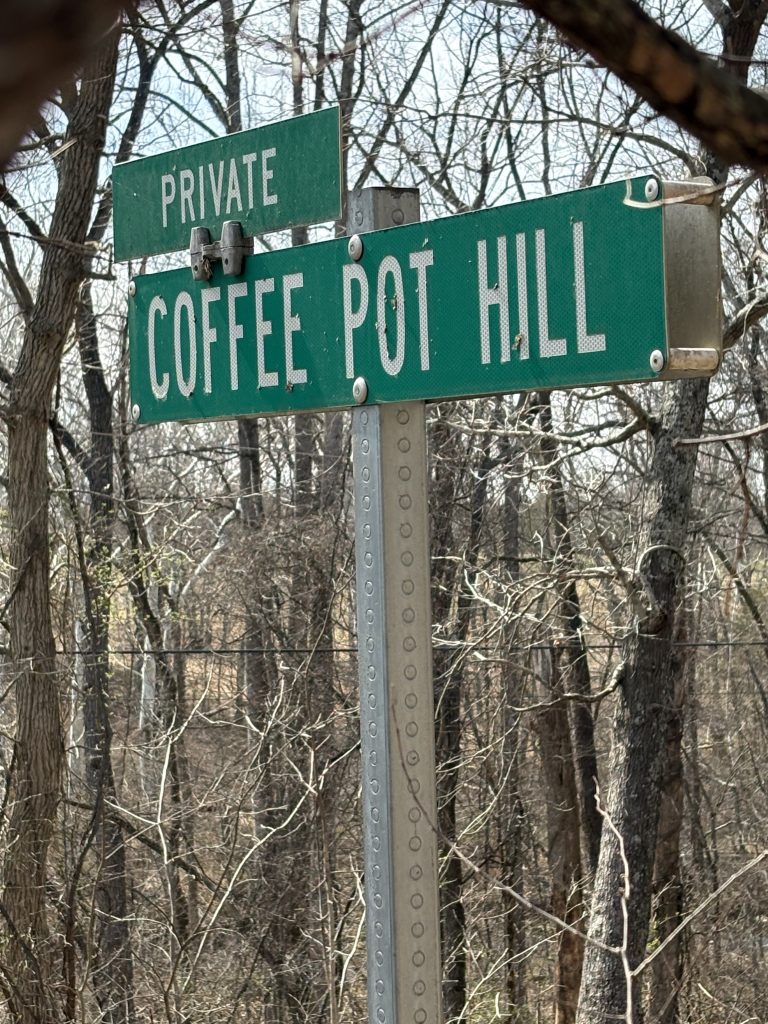
This action is known as “The 2nd Battle of Auburn” and the spot where the battle took place is to this day called “Coffee (Pot) Hill.” The battle went until about 11 AM, and by 1 PM, the Federals had moved towards Catlett Station.
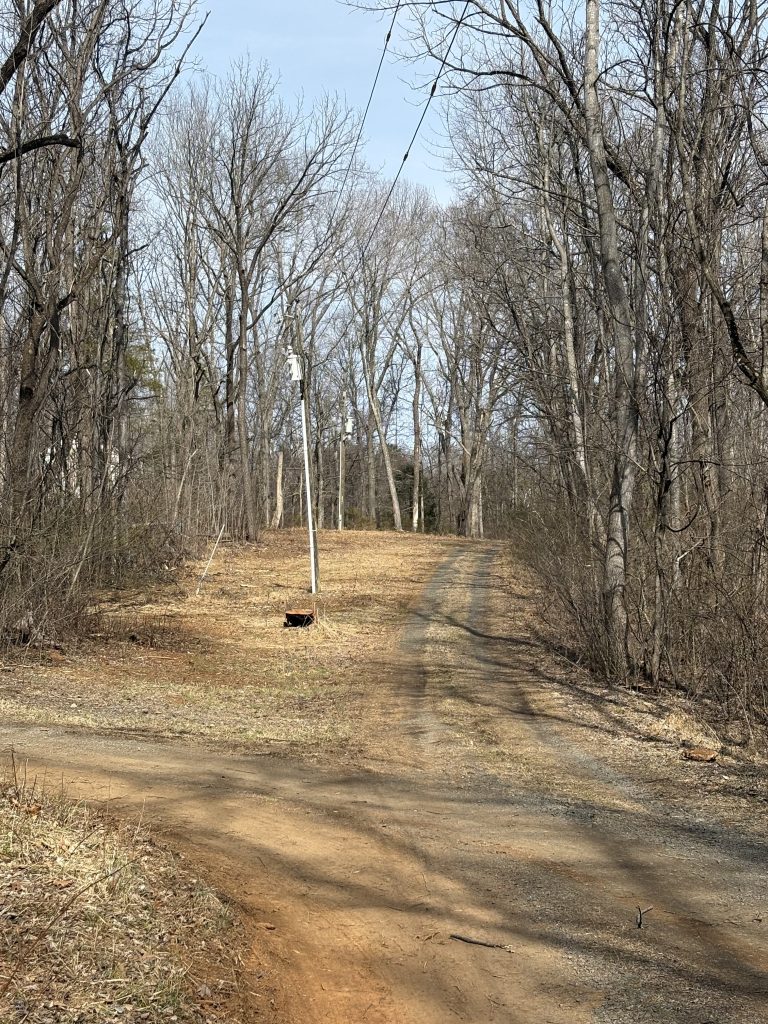
This action is known as “The 2nd Battle of Auburn” and the spot where the battle took place is to this day called “Coffee Pot Hill.” The battle went until about 11 AM, and once the fire stopped, the Division moved east towards Catlett Station, roughly 5 miles away. They likely moved along “the old Dumfries Road” (as it is known today). Roughly 2 miles short of Catlett Station, the Regiment deployed as skirmishers to the left of the road, this duty lasting for several hours. Ultimately, they were relieved by Federal calvary, wherein the Division resumed its march east towards Catlett, before them turning north (likely along the trace of the railway which paralells modern Route 28) towards Bristoe Station, roughly 8 1/2 miles away.
Later that day (about 4PM) Caldwell’s Division reached “a joint of the railroad” just south of the station. (See ABT Map) There they had a hot engagement with an enemy to their direct front, at a range of a thousand yards. The Federal troops remained in position until about 10PM, exposed to enemy artillery fire. Afterwards, the Division crossed the Bull Run Creek at Blackburn’s Ford, and halted 3 miles beyond it, where they formed a line of battle after a long, long day.
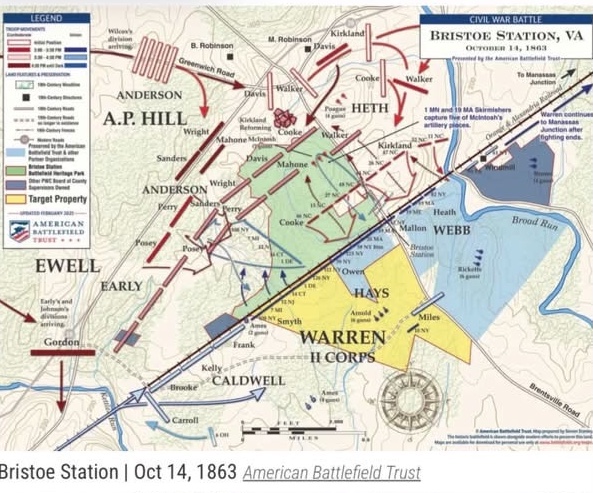
The 4PM engagement was part of the larger Battle of Bristoe Station. Although the 28th was not in the thick of things at Bristoe, they did have another soldier killed and 11 others wounded.
Where the Regiment was engaged at Bristoe Station appears to be outside the current Bristoe Station Battlefield Heritage Park. The ABT is seeking to acquire land (yellow on map) just NE of the Regiment’s position with Kelly’s Irish Brigade. There is no trace of the fighting at Auburn save one – a private country lane climbing the small hill north of the mill at Cedar Run bearing the name “Coffee Pot Hill.”
Sources: Ryan. “Campaigning with the Irish Brigade”, pgs 107-108 and “A Want of Vigilance: The Bristoe Station Campaign, October 9–19, 1863” by Bill Backus. (Mr Backus is in charge of the Bristoe Station Battlefield Heritage Park and has enable the recreated 28th to use the park for events.
Monday, October 19th, 1863. Broke camp, marched back across the Bull Run Creek, Manassas plains, and to within 7 miles of Warrenton Junction. Total distance marched 13 miles.
Tuesday, October 20th, 1863. Marched through Greenwhich, and arrived back at Auburn, having marched 15 miles. Stayed there until October 23rd.
Friday, October 23rd, 1863. Marched towards Warrenton, arriving early afternoon, having marched 12 miles that day. Reminded there until November 7th.
Saturday, October 31st, 1863. Monthly Report: Field/Staff – 6; Co A – 1/21; Co B – 1/20; Co C – 2/20; Co D – 2/23; Co E – 1/25; Co F – 1/25; Co G – 1/23; Co H – 2/25; Co I – 2/25; Co K – 2/27
Total Present – 21/244 Total Present and absent – 24/502 Gain – 15, Loss 37
Saturday, November 7th, 1863. Marched to Kelly’s Ford, a distance of 15 miles.
Sunday, November 8th, 1863. Marched at 8AM, crossed the Rappahannock River at Kelly’s Ford, formed line of battle, and then marched about 2 miles, and halted about Noon. Then marched for 5 miles, and went into camp about 4PM at Perry Hill..
Tuesday, November 10th, 1863. The 28th Mass was temporally detached from the Irish Brigade and was placed on special guard duty at East View, roughly 4 1/2 miles from Brandy Station. remained on detached duty for 16 days.
Thursday November 26th, 1863. Relieved from special guard duty, the Regiment marched to Germanna Ford on the Rapidan and rejoined the Irish Brigade. With the Brigade, crossed the Rapidan, and marched on the Gordonsville Plank Road, camping after 14 miles that day.
Mine Run Campaign
Friday November 27th, 1863. Marched at 8AM on the Gordonsville Plank Road towards Robinson’s Tavern. Formed line of battle and about 4 pm, advanced in front of a position occupied by the enemy, halted and remained in line of battle through the night.
Saturday November 28th, 1963. Advanced at 7 AM in the woods to the front, but the enemy had retired. marched 2 miles towards Orange CH where they remained in the woods overnight.
Sunday, November 29th, 1863. Marched to Robinson’s Tavern, crossed the pike, marched “to the left” about 8 miles, until reaching the Plank Road between Fredericksburg and Orange Court House. (The Orange Turnpike?) Advanced on this road (direction?) until they met the enemy to the right of the road, and deployed as skirmishers. Advanced at 3 pm and immediately were engaged by Reb skirmishers, and were forced back to,a point about a mile from where they started – all under heavy fire – suffered 5 WIA. Assumed picket duty at this point overnight.
Monday, November 30th, 1863. In the evening, relieved from picket duty snd sent back with the whole brigade to guard the ammunition train. The Monthly Report was also submitted: Field/Staff – 7; Co A – 1/24; Co B – 1/22; Co C – 2/18; Co D – 2/21; Co E – 1/26; Co F – 2/27; Co G – 1/25; Co H – 2/26; Co I – 2/24; Co K – 2/25
Total Present – 23/242 Total Present and absent – 24/473 Gain – 3, Loss 32 (21 deserted)
Tuesday December 1st, 1863. At 9 PM, marched “with the rest of the Army” marched all night back to the Rapidan.
Wednesday, December 2nd, 1863. At 5AM, recrossed the Rapidan at Culpepper Ford, halted for an hour, then resumed the March until 2 pm, when they reached Perry Hill, where they camped, having moved 30 miles that day.
Saturday, December 5th, 1863. Marched towards Stevensburg, in Culpepper County, going a distance of 4 miles, camped near the town. (Stevensburg is roughly 7 miles east of the town of Culpepper, along modern VA Route 3.)
Monday, December 7th, 1863. Marched within 2 miles of Stevensburg, and went into winter quarters on Hansbrough’s Ridge, a bout a mile east of the town. Stayed in these quarters until May 1864, “..performing picket guard and other duties.”
Wednesday, December 30th, 1863. Monthly Report: Field/Staff – 6; Co A – 1/25; Co B – 1/25; Co C – 1/19; Co D – 2/21; Co E – 1/27; Co F – 2/27; Co G – 1/26; Co H – 2/25; Co I – 2/22; Co K – 2/27
Total Present – 21/248 Total Present and absent – 25/474 Gain – 12, Loss 11
Closing 1863. At the end of the Regiment’s second full year of Federal Service, a year which saw much marching and hard fighting, the Regiment’s “present” strength had diminished by 76 soldiers to 248 (from 324.). It had gained two officers (21). Its paper strength had also diminished – down 6 officers and 214 soldiers. The Company losses reflect these losses – Co A lost an officer and 17 soldiers; Co B an officer and 5 soldiers; Co C 21 soldiers; Co D an officer and 13 soldiers; Co E 10 soldiers; Co F no change(!); Co G 9 soldiers; Co H gained 1 soldier; Co I lost 11 soldiers, and while Co K gained two,officers, it lost 5.
In total, the 21 officers and 248 men who established winter camp near Stevensburg at the end of 1863 were just a remnant of the 37 officers and 904 soldiers that began active campaigning in the Spring of 1862. 1864 loomed ahead, with more marching and fighting for the Faugh a Ballagh boys.