

Photo Credit: Massachusetts State House Battle Flag Collection
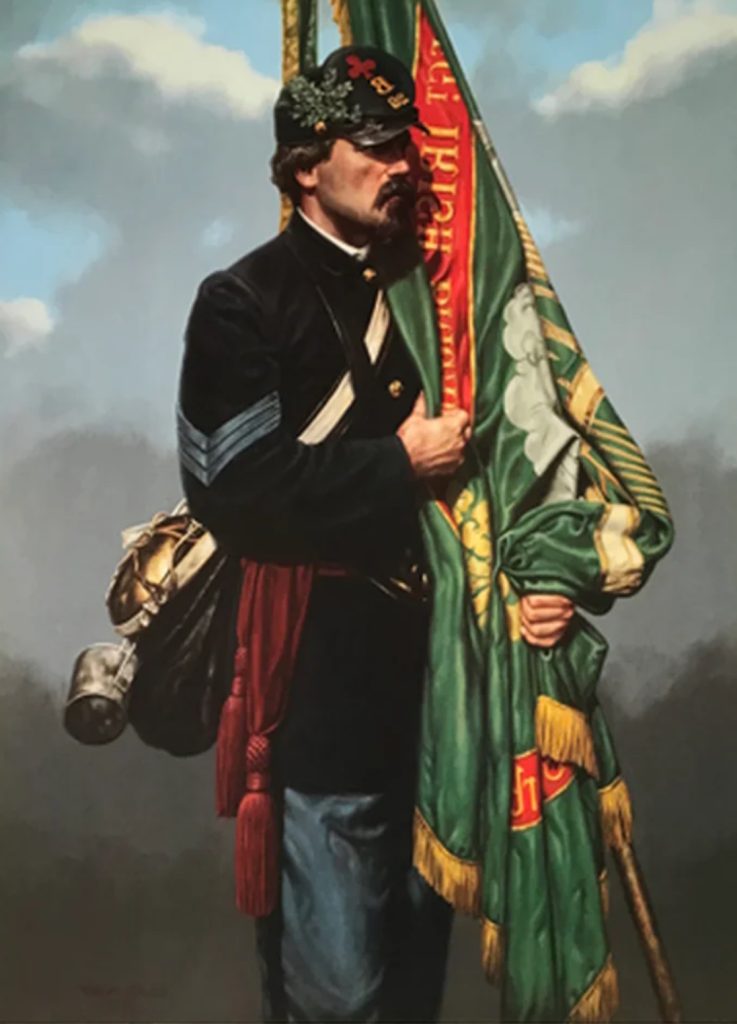
Fourth Irish Color (Grainger Flag). This flag was presented to Colonel Richard Byrnes, Commanding Officer of the Regiment on May 5, 1864, by Boston Mayor Frederic W. Lincoln Jr. It was clearly intended to replace the Pilot flag as the two flags were nearly identical. It was likely both flags were created by the same unknown maker. Notable to the Grainger flag is the addition of some of the Regiment’s battles in its gold painted border. The battles listed – Fredericksburg, Antietam, and Sharpsburg – clearly correlate to the letter written by Captain Sanborn pursuant to the return of the First National in early 1863 (especially given that “Antietam” and “Sharpsburg” are the same battle.)
The Grainger Flag – called such because it was donated in 1925 to the State by a Dr Grainger of New York, whose brother Charles was a Captain in the 69th NY of Irish Brigade, was, like the Pilot Flag, of painted silk. It measured 44.5 by 56.5 inches, making it a bit bigger than the Pilot. The Massachusetts Battle Flag collection holds the flag, and there is no associated staff.
This said, it has been opined that a staff associated with the First State Flag was properly the staff of the Grainger Flag, as it is nearly identical to the staff returned with the Pilot Flag. Lastly, it is unknown how a member of the 69th New York came to hold a flag of the 28th Massachusetts, but in the end, the Flag was returned to its proper home
Which Green Regimental? Considering the issue of the “4th Reg’t Irish Brigade” Tiffany flag in late 1862, and the subsequent issue of the Grainger Flag in May of 1864, it is unclear exactly which green Regimental Color the Regiment carried on a daily basis. Reasonably, one can infer that the Irish Brigade Tiffany was carried through 1863, especially as the Regiment had originally been raised to be part of the Irish Brigade. This view is supported by previous practice– they had carried the Tiffany flag rather than the Pilot flag at Fredericksburg just a few months before, so why not continue this tradition? The laurels and national recognition won by the Irish Brigade no doubt contributed to a preference for the Tiffany.
It is also likely that the somewhat replenished Regiment – with over 500 men due to Colonel Byrnes’ recruiting efforts in the first part of 1864 – likely started the 1864 Overland Campaign with the Tiffany Flag paired with the Third National. However, by mid- June 1864, and following the fatal wounding of Colonel Byrnes at the Battle of Cold Harbor, the Regiment was reduced to roughly 100 men under the command of a Captain.
Due its accumulated losses, after the first assault on Petersburg, on June 20, 1863, the Army of the Potomac briefly disbanded the Irish Brigade and incorporated its
remaining elements int other II Corps Brigades. Although
the Irish brigade was re-constituted in early 1865, it is
conceivable that the remnants of the Regiment reverted to carrying the Grainger Flag during this time.
It is not known specifically which green regimental Color was carried by the Regiment in the fighting in 1865, specifically at the battles of Hatchers Run (March 29) and Sutherland Station (April 2). It may be presumed the Tiffany – as the more famous of the Regimental Colors – was carried in the Grand Review of the Army in Washington DC (May 23).